The very top of the mastering console market is occupied by two UK boutique manufacturers: Maselec and Crookwood. Where SPL represents the German engineering approach with the 120V topology, Maselec and Crookwood represent the British tradition of small-batch, semi-custom mastering electronics built to the highest possible standard regardless of cost. Maselec has been in production since the 1980s under designer Leif Mases (former Polar Studios engineer in Stockholm); Crookwood has been operating from the UK since the 1990s with installations at Abbey Road, Sterling Sound, and Bernie Grundman Mastering. Combined, these two manufacturers equip a substantial share of the world’s flagship mastering rooms.
This guide covers Maselec and Crookwood from a professional mastering engineer’s perspective.
Maselec MTC-1 and MTC-6: the UK boutique standard
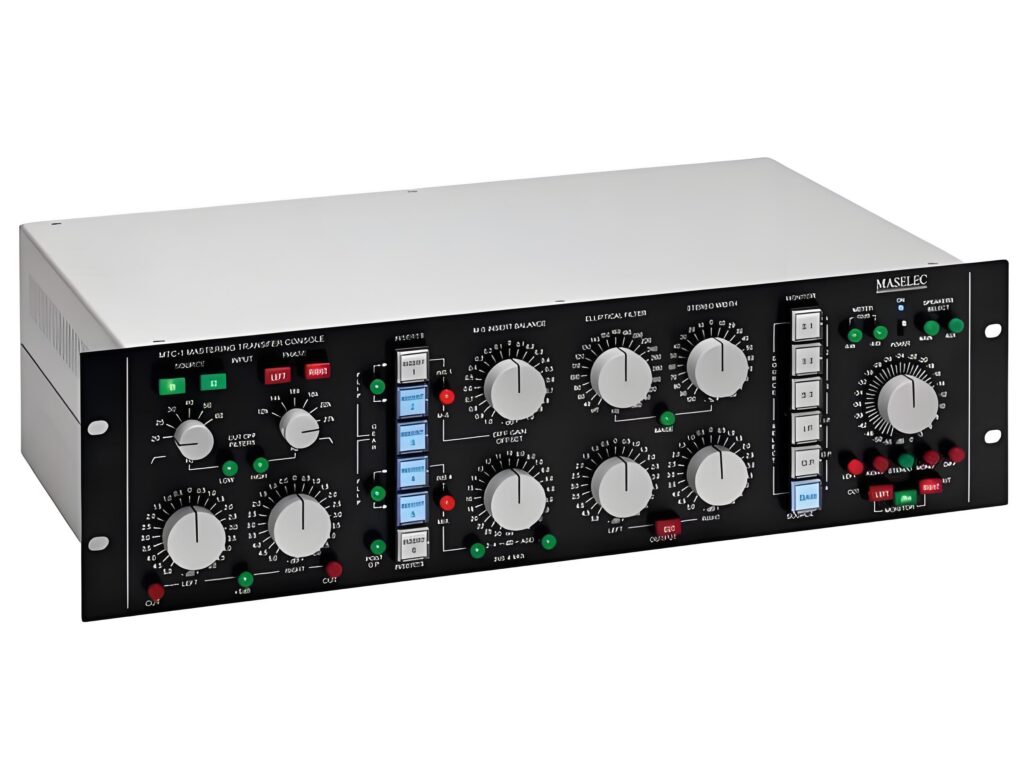
Maselec MTC-1 is the original mastering transfer console — a stereo mastering console with extensive routing flexibility, M/S processing, and the distinctive Maselec sonic character. The signal path uses discrete amplifier circuitry with output transformers that contribute a controlled harmonic enhancement at higher levels. MTC-1 has been in continuous production since the late 1980s with progressive revisions; current MTC-1 frames run 25,000 to 35,000 USD.
Maselec MTC-6 is the larger and more comprehensive mastering console — six insert points instead of two, more flexible monitoring matrix, and additional headphone/talkback infrastructure for client-facing mastering work. MTC-6 is found at high-end mastering rooms worldwide and runs 45,000 to 65,000 USD depending on configuration.
The Maselec sonic character is hard to describe precisely — engineers cite « a particular kind of presence in the low-mid range » and « extremely natural transient response » as defining qualities. The console doesn’t add dramatic coloration the way a vintage Neve might, but it doesn’t disappear either; it imparts a subtle quality that many mastering engineers find essential to their final-stage processing.
Major Maselec installations include Sterling Sound (New York), Bob Ludwig’s Gateway Mastering Studios, and Bernie Grundman Mastering (LA).
Crookwood Mastering Console: bespoke at Abbey Road
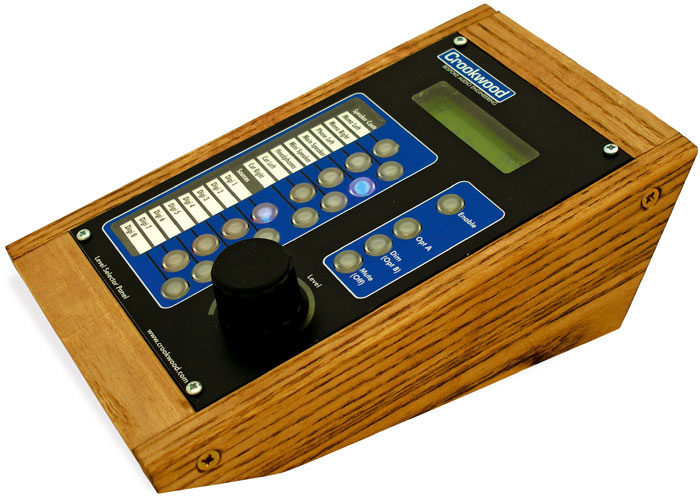
Crookwood takes a different approach: every Crookwood Mastering Console is semi-custom — built to specification for the particular room, engineer, and workflow. The standard Crookwood architecture includes a stereo signal path with very flexible insert routing, a sophisticated monitoring section, and proprietary attenuation circuitry that mastering engineers describe as exceptionally transparent.
The flagship Crookwood installation is Abbey Road’s Mastering Suite, where a custom Crookwood console replaced the legacy EMI/Abbey Road custom mastering console in 2010. Other major installations include Stardelta Mastering (UK), several Universal Music mastering rooms, and a number of independent boutique mastering operations.
Crookwood pricing is project-specific but typically runs 40,000 to 90,000 USD depending on configuration and customization. The lead time for a new Crookwood is typically 6-12 months, reflecting the bespoke build approach.
For broader mastering equipment context, see best mixing console for mastering studio 2026.
Why boutique mastering consoles matter
The case for spending 40,000-90,000 USD on a boutique mastering console rather than 5,000-15,000 USD on a high-quality monitor controller plus passive summing comes down to several factors:
1. Sonic character. Maselec and Crookwood consoles impart a specific quality that mastering engineers identify as essential to their work. This isn’t measurable in distortion specs — it’s the kind of thing that becomes apparent only under prolonged critical listening on world-class monitors.
2. Operational ergonomics. A purpose-built mastering console has the right controls in the right places for the mastering workflow. M/S encode/decode is a single switch; multiple insert points are clearly labeled and instantly accessible; the monitor matrix has dedicated controls rather than menu-driven options.
3. Reliability and service. Both Maselec and Crookwood offer 25+ year service support. An MTC-1 from 1995 can still be sent back to Maselec for full refurbishment; a Crookwood from 2005 can be updated with current specifications.
4. Client-facing presentation. Major-label and high-budget mastering clients expect to see a serious-looking dedicated mastering console in the room. This is not a trivial consideration — mastering is partly a service business, and the room aesthetic matters.
For more on the broader analog vs digital question, see digital vs analog pro mixing console comparison.
Maselec/Crookwood vs SPL DMC vs alternatives
Among dedicated mastering consoles, the choice typically comes down to:
- SPL DMC — the right answer for engineers who want German engineering, 120V topology, and integrated SPL ecosystem (PQ, Iron, Hermes)
- Maselec MTC-1/MTC-6 — the right answer for engineers who want the British boutique character and proven major-label pedigree
- Crookwood — the right answer for engineers who want a bespoke build tailored to their specific room and workflow
- Passive summing + monitor controller — the right answer when budget is constrained and the engineer prefers to work primarily ITB with analog summing only
For broader vintage console context, see our vintage mixing console restoration guide.
Where Maselec and Crookwood fit in a 2026 facility
These boutique mastering consoles are the natural specification for:
- Major-label commercial mastering rooms targeting flagship-tier projects
- Boutique mastering operations differentiating on sonic character
- Long-term mastering operations where 25-year ownership horizon matters
- High-visibility installations (Abbey Road, Sterling Sound, Bernie Grundman, Gateway) where the console is part of the studio’s identity
For a complete mastering room walkthrough, see our best mastering console buyer guide.
Where to buy Maselec and Crookwood consoles
Both Maselec and Crookwood are typically sold direct from the manufacturer rather than through general pro audio retail. Maselec consoles can occasionally be specified through Sweetwater (US) or specialist dealers (Atlas Pro Audio, Vintage King’s mastering team), but factory direct is the most common path. Crookwood is essentially always factory direct with custom specification meetings — often involving the engineer flying to the UK for design consultation.
Used Maselec MTC-1 and MTC-6 frames very rarely appear on the used market; when they do, they trade at near-new prices, reflecting the small production runs and long-term value retention.
Bottom line
Maselec and Crookwood occupy the very top of the mastering console market in 2026. For mastering engineers committed to the boutique British tradition and willing to invest in a 20-25 year instrument, both manufacturers deliver world-class results. Crookwood for bespoke builds; Maselec for the proven catalog production.
For the broader context on professional mixing consoles, return to our professional mixing console 2026 expert guide.
→ See all our Le Fader ratings
See mixing consoles on Thomann →
🎚️ Essential accessories for your mixing console
As an Amazon Associate I earn from qualifying purchases.