
The SPL DMC (Dual Mastering Console) is one of the few purpose-built mastering consoles still in active production in 2026. Founded in Germany in 1984 by Wolfgang Neumann, SPL — Sound Performance Lab — built its reputation on the 120V audio rail technology, a discrete amplifier topology that operates at significantly higher voltage than typical pro audio circuits (120 volts versus the conventional 30 volts). The result is exceptional headroom, low THD, and a sonic signature that mastering engineers have valued for two decades. The DMC is the flagship implementation of this technology in console form.
This guide covers the SPL DMC and the broader SPL mastering electronics ecosystem from a professional mastering engineer’s perspective.
The SPL DMC: what it is and what it does
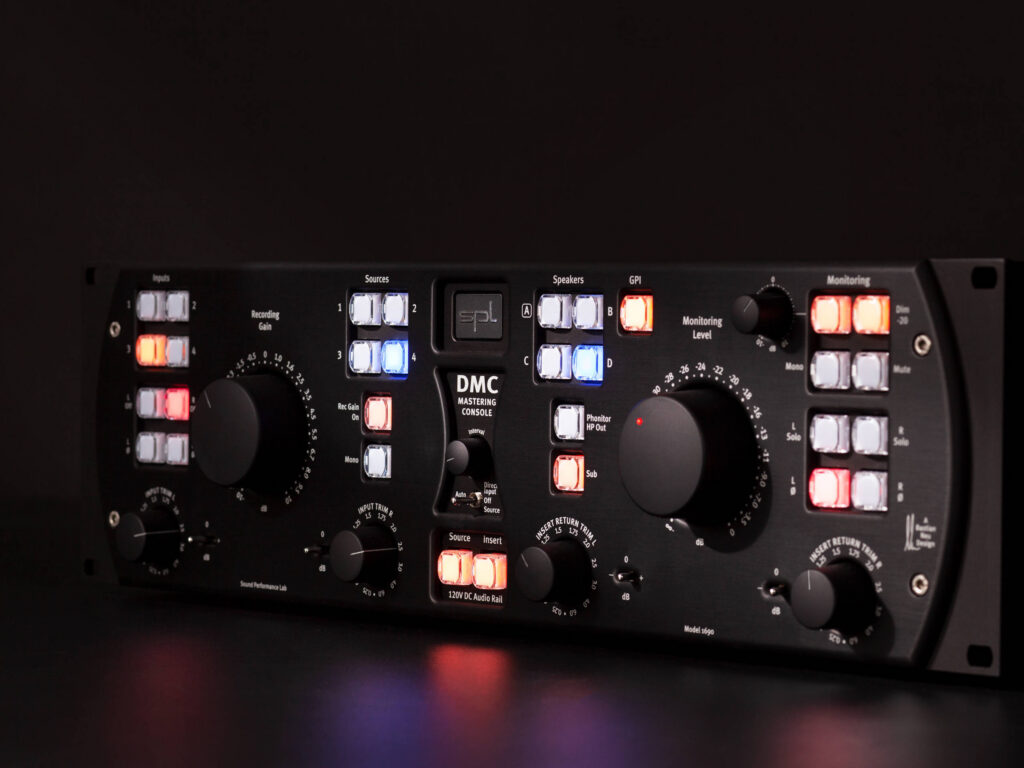
SPL DMC is a dedicated mastering console — not a recording or mixing console adapted to mastering, but a console specifically designed for the workflow of stereo mastering. The signal path is two-channel only, with extensive M/S (Mid/Side) processing capability, multiple parallel processing chains, and a monitoring section optimized for critical mastering listening.
Key technical features:
- 120V audio rail throughout the signal path — discrete amplifiers operating at ±60V supplies, delivering measurably higher headroom than ±15V or ±18V circuits
- Dual stereo path — two independent stereo signal paths that can be summed, compared, or routed in parallel for multi-stage processing
- M/S encoder/decoder built in — converting stereo to Mid+Side and back, allowing independent processing of mid and side information
- Insert points for outboard processors at multiple positions in the signal chain
- Monitoring matrix — sophisticated monitor controller supporting multiple speaker pairs, headphones, multiple sample rate inputs, and dim/cut/sum controls
DMC pricing typically runs 35,000 to 55,000 USD (depending on configuration and currency — the console is German-built and EUR pricing is the manufacturer reference, with USD typically 1.05-1.15x EUR depending on exchange rate).
SPL mastering electronics: the broader ecosystem
The DMC is typically deployed as the central monitor and routing console in a mastering rack that includes other SPL processors:
SPL PQ — fully analog mastering parametric EQ, four bands plus high/low shelves, M/S capability. Deployed in many of the world’s top mastering rooms.
SPL Iron — dual valve mastering compressor with vintage-character compression and SPL’s discrete topology in the signal path.
SPL Hermes — passive mastering EQ inspired by Pultec and Manley topology, with SPL’s modern discrete buffering.
SPL Crimson — newer reference monitor controller, often deployed alongside DMC for additional speaker switching capability.
A typical SPL mastering chain might be: source → SPL PQ (broad tonal shaping) → SPL Iron (dynamic control) → SPL DMC (M/S processing, monitoring, summing) → output. Engineers who prefer this signal flow describe it as “transparent with character” — the 120V topology adds harmonic content but doesn’t impose dramatic tonal coloration.
SPL DMC vs the alternatives
In the mastering console market specifically, the DMC competes with several alternatives:
vs Maselec MTC-1 / MTC-6 — the Maselec MTC is the UK alternative, with a different sonic philosophy (more transparent, less character-driven) and a strong following at high-end mastering rooms. Both are credible flagship choices.
vs Crookwood Mastering Console — Crookwood is more bespoke and customizable; SPL DMC is more standardized but more readily available.
vs Dangerous Music Liaison/D-Box+ — Dangerous offers a more compact, less expensive monitor controller approach for engineers who don’t need full DMC processing depth. Common at smaller mastering rooms or as a backup system.
vs DIY/passive summing — engineers who don’t need the full DMC signal path and processing flexibility may opt for passive summing (Folcrom, Roll Music Folcrom, Highland Dynamics) plus separate monitor controllers and outboard. This is a credible alternative at significantly lower cost — but DMC’s integrated approach is operationally faster.
For broader mastering equipment context, see best mixing console for mastering studio 2026.
What “mastering console” actually means in 2026
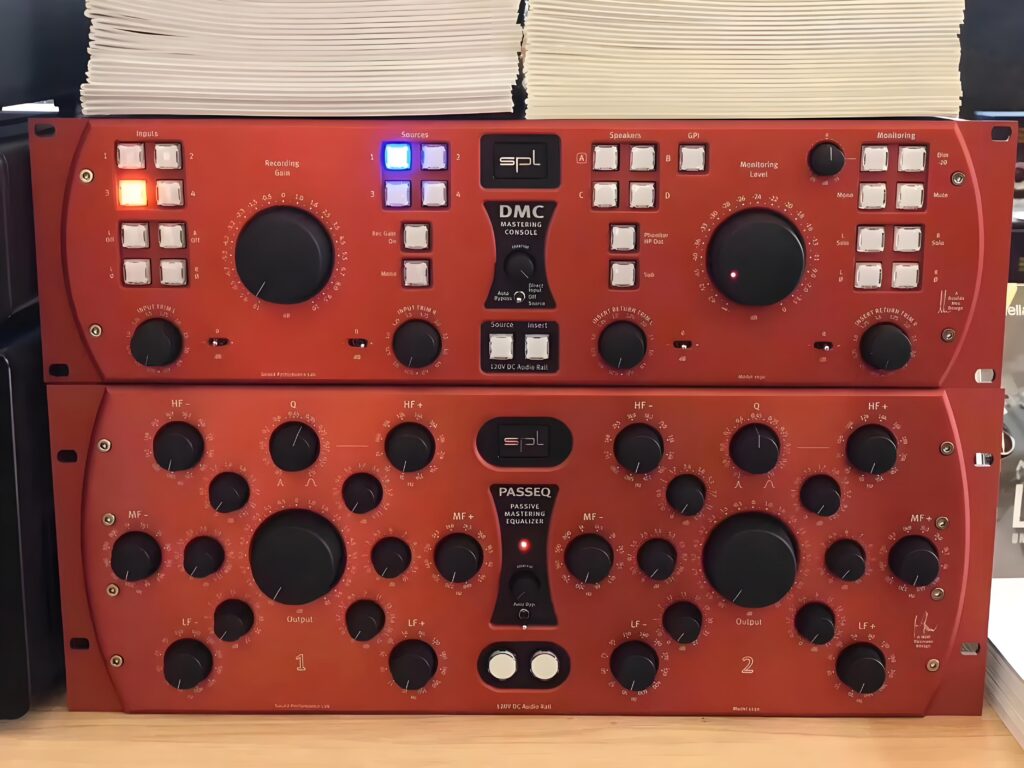
A mastering console is fundamentally different from a mixing console. The differences:
Channel count. Mastering consoles are stereo-only (two channels in, two channels out, possibly with M/S encoded paths). Mixing consoles need 24+ channels.
Signal path priority. Mastering consoles prioritize absolute transparency or controlled coloration on the stereo bus — every component matters because the signal passes through with no other tracks to mask flaws. Mixing console designs distribute compromises across many channels.
Monitoring matrix. Mastering consoles include sophisticated monitor controllers — multiple speaker pairs, multiple sample-rate sources, integrated dim and cut controls, headphone routing for clients. This is not optional in a serious mastering room.
Insert flexibility. Mastering work involves swapping outboard processors between sessions and projects. The console must accommodate flexible signal flow with minimal repatching.
For more on the broader analog vs digital question, see digital vs analog pro mixing console comparison.
Where SPL DMC fits in a 2026 facility
SPL DMC is the natural specification for:
- New mastering rooms starting fresh with a coherent SPL ecosystem (DMC + PQ + Iron)
- Mastering engineers who specifically want the 120V sonic signature
- European mastering rooms (where SPL has a strong incumbent presence)
- Mastering operations that handle both stereo and surround/immersive work (DMC integrates with SPL surround processors)
For a complete mastering room walkthrough, see our best mastering console buyer guide.
Where to buy SPL DMC and mastering electronics
SPL pro audio is available through Sweetwater (US), B&H Photo (US), and Thomann (EU). Thomann offers the most competitive EU pricing on SPL gear — SPL is German-built and Thomann is the natural retail channel for European customers. Sweetwater handles US installations with mastering-room consultation support. Specialist mastering dealers (Atlas Pro Audio, Vintage King’s mastering team) handle some DMC sales in the US.
Used SPL gear (PQ, Iron, Hermes) trades on Reverb.com. Used DMC consoles are uncommon — most installations stay in service for decades.
Bottom line
SPL DMC is one of the few mastering-purpose consoles in active production in 2026. The 120V topology delivers measurable headroom and a distinctive sonic signature that defines a substantial share of the world’s mastering rooms. For engineers committed to discrete analog mastering with character, DMC is a default specification.
For the broader context on professional mixing consoles, return to our professional mixing console 2026 expert guide.
Where to buy : SPL DMC
| Retailer | Why | |
|---|---|---|
| Thomann | Reference price, 3-year warranty, pro stock in Europe | Check price at Thomann → |
| Amazon | Fast shipping, used and renewed units | See on Amazon → |
Affiliate links: the price is the same for you, the commission funds our tests. As an Amazon Associate we earn from qualifying purchases.
Read also: Maselec and Crookwood boutique mastering consoles: pro guide
Sources — manufacturer documentation consulted for this article: SPL.
→ See all our Le Fader ratings
🎚️ Essential accessories for your mixing console
As an Amazon Associate I earn from qualifying purchases.