
Broadcast TV and radio mixing console setups operate under fundamentally different constraints than music recording or live sound. The console must handle simultaneous multi-format outputs (stereo, 5.1, Atmos, multilingual feeds), integrate deeply with video facility infrastructure, support 24/7 operation in some installations, and meet broadcast regulatory standards (loudness compliance, EBU R128, ATSC A/85). Total broadcast facility installations range from 400,000 USD for a regional TV studio to 8,000,000+ USD for a flagship public broadcaster’s main TV center or a premier OB truck. This guide covers the console-centric architecture for broadcast TV and radio facilities, including studio installations, master control rooms, and outside broadcast (OB) trucks.
For broader context, see our pillar guide to professional mixing consoles 2026, our best mixing console for broadcast TV/radio 2026 buyer guide, and our multi-format routing for broadcast guide.
Console categories for broadcast applications
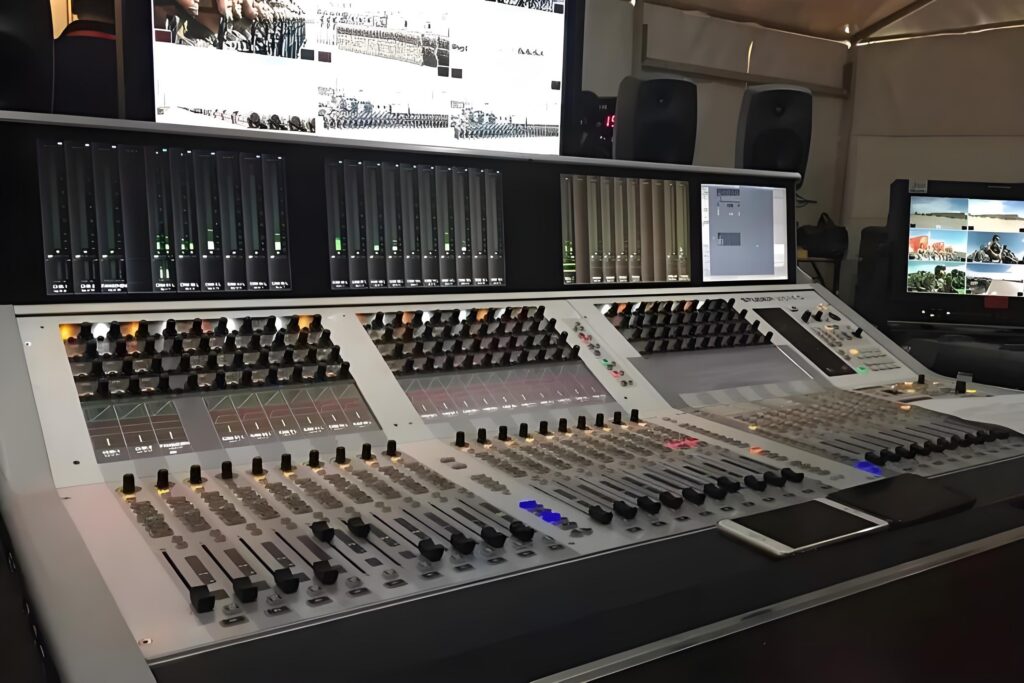
Three console categories handle different broadcast use cases:
Broadcast specialty consoles — purpose-built for TV/radio with multi-format routing, network audio integration, and broadcast-specific feature sets:
- Studer Vista series — Vista 1, Vista 5, Vista 9, Vista X, Vistonics interface, the European public broadcaster reference
- Lawo mc² — mc²36, mc²56, mc²96, IP-native, common in flagship TV studios and high-end OB
- Calrec Apollo / Summa / Brio / Argo — UK broadcast standard, Hydra2 networking, common at BBC, Sky, ITV
These consoles range 200,000-1,500,000 USD per installation depending on configuration.
Live sound consoles adapted for broadcast — primarily Avid VENUE for award shows, Olympics broadcasts, and special events:
- Avid VENUE S6L — common at Grammys, Oscars, late-night TV shows for music performances and large-scale broadcast events with music focus
Compact broadcast consoles — for small TV studios, regional broadcasters, news studios, smaller radio operations:
- Lawo mc²36 (~150,000 USD) — entry-level pro broadcast
- Calrec Brio (~50,000 USD) — compact broadcast
- Studer OnAir 1500/2500 (~25,000-60,000 USD) — Studer’s compact line
- Wheatstone L-12 / G-12 — radio-focused compact consoles
TV studio facility setup
A flagship TV studio (network or premier public broadcaster) typically includes:
Studio control room — primary console (Studer Vista X, Lawo mc²96, Calrec Apollo) with 96-256 input channels, 64-128 output buses, multiple monitor positions for sound mixer, music mixer, dialogue mixer, and producer.
Master control / continuity — Wheatstone, Logitek, Studer OnAir, or compact Lawo / Calrec consoles handle network programming, commercials, and live continuity.
Production audio routing — typically built around an audio router (Lawo Nova73, Calrec Hydra2, Studer Routing System, or third-party SDI/IP routers). The audio router interconnects studios, edit suites, master control, ingest, and external sources.
Network audio fabric — Ravenna (AES67), Dante, or proprietary networks (Lawo, Calrec). IP-native installations use ST 2110 standards for SDI replacement.
Loudness management — TC Electronic, Junger, or Linear Acoustic loudness processors ensure compliance with EBU R128 (Europe), ATSC A/85 (North America).
Tally and intercom integration — RTS Bolero, Clear-Com FreeSpeak, or Riedel Bolero wireless intercom integrated with the console.
A typical flagship TV studio audio setup runs 600,000-1,200,000 USD, integrated with the broader video facility costing 5,000,000-25,000,000 USD.
Outside broadcast (OB) truck setup
OB trucks bring the broadcast facility to live events — sports, concerts, news, public events. A flagship OB truck (Telegenic, NEP, Mediapro, NHK, BBC) houses an entire broadcast facility in a 14-meter expanding trailer.
Console — Lawo mc²96 or Calrec Apollo, with 128-256 inputs, 64-128 outputs. Some flagship trucks deploy two consoles for music and dialogue mixers operating simultaneously.
Stagebox infrastructure — typically 64-200 mic input racks with redundant network paths (fiber to the truck). Calrec Hydra2 stageboxes, Lawo A_stage stageboxes, or Studer Stageboxes.
Routing and monitoring — internal IP audio fabric (typically Ravenna/AES67 or proprietary) with comprehensive monitoring positions for the audio crew of 4-8 engineers.
Truck integration — audio integrates with video routing, vision mixing, replay (EVS), graphics, and transmission via SDI embedded audio, MADI, or IP transport. Audio over IP (ST 2110-30) is now standard in modern flagship trucks.
A flagship OB truck represents 4,000,000-15,000,000 USD complete (audio is typically 800,000-2,500,000 USD of that).
Radio facility setup
Radio is operationally simpler than TV but uses purpose-built consoles:
Studio consoles — Lawo Crystal, Studer OnAir, Wheatstone L-Series, Logitek Mosaic, AEQ Forum/Capitol. Designed for talk and music format management, profile recall for different shows, integrated telephone hybrid management, and codec management.
Master control — Wheatstone, AEQ, or other broadcast-specialty consoles for network distribution.
Talkback and IFB — extensive intercom and producer-talent communication infrastructure, often integrated into the console.
A typical flagship radio studio installation runs 80,000-400,000 USD per studio. Major networks operate 12-30 studios at a single facility.
Network audio and IP infrastructure
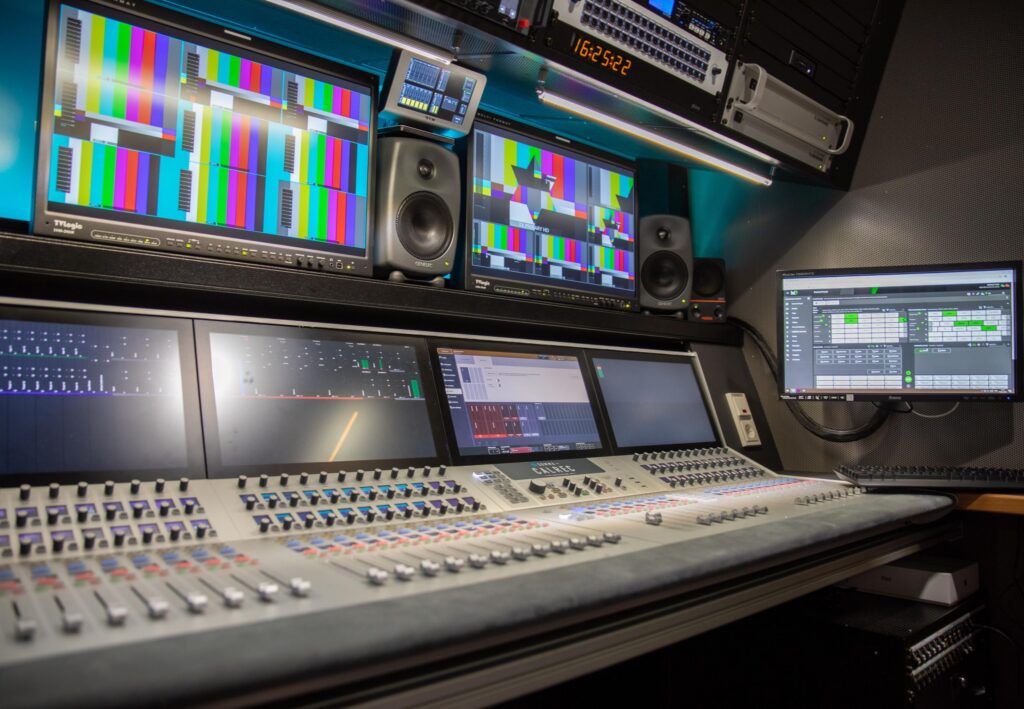
The 2026 broadcast facility runs on IP audio:
ST 2110-30 — uncompressed PCM audio over IP, the SDI replacement standard AES67 — vendor-neutral IP audio interoperability standard Ravenna — Lawo’s primary IP audio implementation (AES67-compatible) Dante — Audinate’s IP audio standard, common in TV and radio Calrec Hydra2 — Calrec’s proprietary network (AES67 gateway available) Studer A-Link — Studer’s proprietary network
Most modern broadcast installations support multiple protocols simultaneously through gateways. A flagship facility might run Hydra2 internally with Dante and ST 2110 gateways for external connectivity.
Loudness, monitoring, and compliance
Broadcast operates under strict regulatory loudness standards:
- EBU R128 (Europe) — target -23 LUFS integrated, -2 dBTP true peak
- ATSC A/85 (North America) — target -24 LUFS integrated
- ARIB TR-B32 (Japan) — target -24 LKFS
Loudness management is integrated through:
- Loudness meters at every mix position (TC Electronic LM6, Nugen MasterCheck, Junger LD250)
- Loudness processors at transmission (Junger D*AP, Linear Acoustic AERO, TC Electronic DB6)
- File-based loudness verification for prerecorded content
Monitoring infrastructure follows ITU-R BS.1116 standards for critical listening rooms.
Redundancy in broadcast
Broadcast facilities require comprehensive redundancy:
- Console processing redundancy — Lawo Power Core, Calrec Bluefin, Studer DSP run redundant DSP cards with seamless failover
- Network redundancy — dual-network infrastructure (typically two independent Ravenna or Hydra2 networks)
- Power redundancy — UPS, generator backup, dual power feeds to all critical equipment
- Studio redundancy — backup studios ready to take air if primary studio fails
24/7 operations cannot tolerate downtime — failures must be invisible to viewers and listeners.
Sample budget — regional flagship TV studio
A regional TV station main studio with a national network feed:
- Main console (Calrec Brio or Lawo mc²36): 100,000 USD
- Master control console (Studer OnAir): 35,000 USD
- Audio router and Hydra2/Ravenna fabric: 80,000 USD
- Stagebox infrastructure: 65,000 USD
- Loudness and processing: 35,000 USD
- Monitoring and acoustic treatment: 50,000 USD
- Cabling and integration: 60,000 USD
- Total audio: ~425,000 USD
A flagship public broadcaster facility (BBC New Broadcasting House tier) runs 8-15× this figure across multiple studios and master control rooms.
Bottom line
Broadcast TV and radio mixing console setups are integrated facility installations rather than standalone console deployments. The console is one component of a broader video, audio, and IP infrastructure, but it remains the critical mixing position where program audio is balanced and prepared for transmission.
Specialty broadcast manufacturers (Studer, Lawo, Calrec) dominate flagship installations, with their consoles purpose-built for the multi-format routing, network integration, redundancy, and loudness compliance that broadcast demands. Music-focused live sound consoles (Avid VENUE) deploy at music-driven broadcast events but remain secondary in core broadcast facilities.
For deeper analysis of the broadcast console manufacturers, see our brand guides on Studer, Lawo, and Calrec. For technical depth on the routing demands these systems handle, see our multi-format routing for broadcast guide.
Return to our pillar guide to professional mixing consoles 2026 for the complete professional mixing console landscape.
Read also: Flagship recording studio mixing console setup: pro reference · Arena and festival live sound mixing console setup: pro guide
🎚️ Essential accessories for your mixing console
As an Amazon Associate I earn from qualifying purchases.