The broadcast mixing console market in 2026 is dominated by four major players — Studer Vista, Lawo mc², Calrec, and SSL System T — plus credible alternatives from Avid (VENUE S6L for music broadcast) and Yamaha (Rivage PM and CL series). For broadcast facility planners specifying a new console in 2026, the choice involves not just sonic and operational considerations, but deep questions about IP infrastructure, redundancy architecture, regional service support, and engineer training continuity.
This guide cuts through manufacturer marketing to give working broadcast engineers and facility planners a useful framework for choosing a broadcast mixing console — what to consider, what each major option delivers, and how to match the console to your specific broadcast operation.
Buying framework: what defines a « best » broadcast console
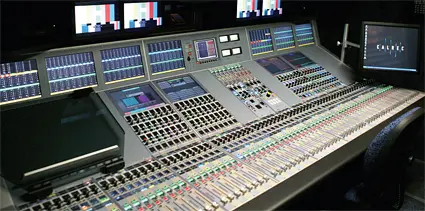
Several factors uniquely matter in broadcast that don’t apply to recording or live sound:
1. IP infrastructure compatibility. SMPTE ST 2110, AES67, NMOS IS-04/IS-05 — modern broadcast facilities are transitioning to IP-native infrastructure. A console specified in 2026 should be IP-native or have a credible IP-transition path. Legacy MADI/SDI workflows still exist but are increasingly being phased out at the major broadcast tier.
2. Redundancy architecture. Broadcast operations cannot tolerate audio dropouts. Console specifications must include redundant power, redundant DSP engines, automatic failover, and dual-redundant network paths.
3. Service support cycle. Major broadcasters expect 15-25 year operational lifespan from a console. Specifications must include long-term parts availability, software update commitments, and regional service support.
4. Operator workflow ergonomics. Live broadcast operations require fast, eyes-up operation under pressure. Touchscreen-only approaches are problematic; physical controls with consistent layouts matter enormously for skilled operator productivity.
5. Snapshot recall reliability. Broadcast operations switch between programs, commercials, and live segments rapidly. The console’s snapshot system must be fast and recall-accurate.
6. Multi-format routing. Modern broadcast handles stereo, 5.1, 7.1, immersive (Atmos, MPEG-H), and multiple language feeds simultaneously. The console must handle these formats without operational complexity. See multi-format routing for broadcast mixing consoles.
7. Engineer training continuity. Major broadcasters have engineering staff trained on specific console families. Switching brands creates retraining cost and operational risk.
The major options for broadcast in 2026
Studer Vista series
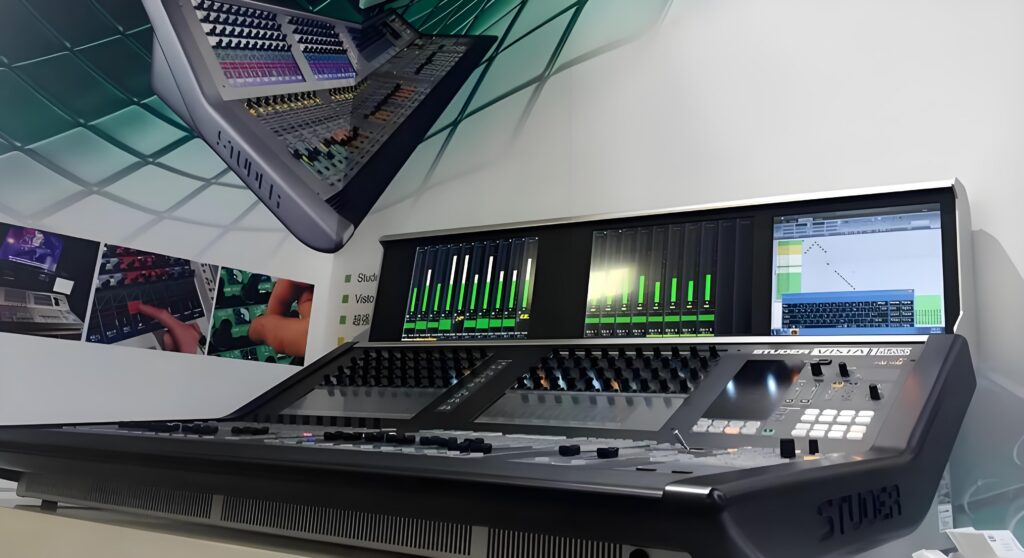
Studer Vista is the European public broadcast standard. Vista 1, 5, 9, X, and the IP-native Vista V cover the full range from regional radio to flagship TV production.
Strengths: Vistonics interface (uniquely effective hybrid touchscreen-rotary control), 25+ year service support, deep European public broadcast incumbency (BBC, ARD, ZDF, RAI, France Télévisions), proven snapshot recall system.
Weaknesses: less aggressive on IP-native architecture than Lawo (Vista V is IP-native but less mature than mc²), smaller US footprint than Calrec or Avid.
Best for: European public broadcasters with installed Studer base, post-production houses, large OB trucks, institutional broadcast (university, government).
Pricing: Vista 1 from 90,000 USD; Vista 5 at 180,000-280,000 USD; Vista 9 at 280,000-500,000+ USD; Vista X at 500,000-1,200,000+ USD.
Lawo mc² series
Lawo mc² is the IP-native broadcast flagship. mc² 36, 56, 96 cover the full range with Ravenna AES67 / SMPTE ST 2110 native networking.
Strengths: most mature IP-native architecture in broadcast, deep integration with Lawo Nova73 router (audio + video + control on single fabric), strong incumbent position in German-speaking and Eastern European markets, scalable from regional broadcaster to flagship facility.
Weaknesses: smaller historical install base than Studer or Calrec, requires retraining for engineers without Lawo background, learning curve for IP-native workflow.
Best for: new broadcast facility builds with IP-native architecture as explicit requirement, ST 2110 transition projects, integrated audio/video facilities, remote production workflows.
Pricing: mc² 36 at 90,000-180,000 USD; mc² 56 at 250,000-450,000 USD; mc² 96 at 600,000-1,500,000+ USD.
Calrec Apollo, Summa, Brio, Argo
Calrec is the UK broadcast standard and dominates major sports broadcast worldwide.
Strengths: unmatched track record in major sports broadcast (NFL, Premier League, Olympics, World Cup), Hydra2 networking is widely regarded as the most reliable proprietary broadcast network, exceptional channel count scalability (up to 1,020 inputs), strong UK service support.
Weaknesses: legacy Apollo and Summa are not IP-native (Argo is the IP-native flagship for new builds), proprietary Hydra2 network limits interoperability, primarily UK-centric service and training infrastructure.
Best for: major sports broadcast (OB trucks for major events), UK broadcast facilities, large international broadcast with multi-feed requirements, applications where Hydra2 reliability is critical.
Pricing: Brio at 50,000-80,000 USD; Summa at 200,000-400,000 USD; Apollo at 500,000-2,000,000 USD; Argo at 350,000+ USD.
SSL System T
SSL System T is SSL’s IP-native broadcast flagship, gaining traction at major broadcasters.
Strengths: IP-native architecture from the ground up, Tempest processing engine, integration with Dante and ST 2110, growing deployment at major broadcasters (Sky Sports, BBC outside broadcast, NHK).
Weaknesses: smaller install base than Studer/Lawo/Calrec, less mature ecosystem than competitors, fewer regional integrators globally.
Best for: broadcasters wanting an IP-native alternative to Lawo, applications where SSL brand and engineering pedigree are valued, mid-tier broadcast facilities.
Pricing: S300 from 90,000 USD; S500 at 200,000-400,000 USD; flagship configurations at 500,000+ USD.
Avid VENUE S6L (broadcast applications)
Avid VENUE S6L is widely deployed in US broadcast for music TV and live performance applications where Pro Tools integration matters.
Strengths: Pro Tools integration class-leading (essential for broadcast music applications), AAX plugin parity with studio sessions, strong US broadcast incumbency (NFL Sunday TV, network late-night bands, award shows).
Weaknesses: not designed for general broadcast routing (better for music broadcast specifically), less robust multi-format routing than dedicated broadcast specialists.
Best for: broadcast music applications (TV bands, award shows, NFL halftime), Broadway and theatrical live broadcast, hybrid live-and-recording applications.
Pricing: S6L-32D system at 150,000-220,000 USD typical.
Yamaha Rivage PM and CL series
Yamaha Rivage PM10/PM7 and CL5 are widely deployed in broadcast, particularly in Asian markets and for mid-tier broadcast applications.
Strengths: mature Dante networking (interoperable with most other manufacturers), strong reliability track record, competitive pricing, broad parts availability, deep Asian market presence.
Weaknesses: less IP-native than Lawo, less specialized for broadcast than dedicated broadcast specialists.
Best for: Asian broadcasters, mid-tier broadcast facilities, broadcast operations with Dante-centric infrastructure, budget-conscious flagship broadcast builds.
Pricing: Rivage PM7 at 110,000-165,000 USD; CL5 at 28,000-65,000 USD (full system).
How to choose: decision framework
For a flagship European public broadcaster:
- First choice: Studer Vista X or Vista 9 (incumbent, long-term support)
- Second choice: Lawo mc² 56 or 96 (IP-native if new build)
- Third choice: Calrec Apollo (if UK-affiliated or major sports requirements)
For a major US broadcaster (network TV music or sports):
- First choice (sports): Calrec Apollo Plus (NFL/NBA-tier sports broadcast)
- First choice (music TV): Avid VENUE S6L (Pro Tools integration)
- Second choice: Lawo mc² 56 (for new IP-native broadcast facilities)
For a new IP-native broadcast facility build:
- First choice: Lawo mc² 56 or 96 (most mature IP-native architecture)
- Second choice: Calrec Argo (Calrec’s IP-native flagship for new builds)
- Third choice: SSL System T (IP-native alternative)
For a major sports broadcast OB truck:
- First choice: Calrec Apollo Plus (the proven sports broadcast flagship)
- Second choice: Lawo mc² 96 (for IP-native sports broadcast operations)
- Third choice: Studer Vista X (for broadcasters with installed Studer base)
For a mid-tier broadcast facility:
- First choice: Lawo mc² 36 (IP-native, future-proof)
- Second choice: Calrec Summa (proven mid-flagship)
- Third choice: Yamaha Rivage PM7 (cost-effective with Dante)
For a regional radio or smaller TV studio:
- First choice: Studer Vista 1 or Calrec Brio (entry into specialist broadcast brands)
- Second choice: Yamaha CL5 (broad capability at competitive pricing)
- Third choice: Lawo mc² 36 in compact configuration
For application-specific guidance, see broadcast TV/radio mixing console setup guide.
Where to buy
Broadcast consoles are typically sold through factory direct (manufacturer regional offices) or authorized broadcast integrators rather than through general pro audio retail. Sweetwater (US) and Thomann (EU) carry smaller broadcast configurations (Brio, Vista 1, mc² 36 compact). Major installations go through:
- Studer/Evertz factory teams
- Lawo regional offices (Lawo USA, Lawo Asia, Lawo AG Germany)
- Calrec North America for US/Canadian installations
- SSL Live specialists for System T
- Avid Pro Solutions specialists for S6L broadcast installations
Regional broadcast integrators (Soundvision, Storyline in Europe; AVI-SPL, Diversified, GRA in US) handle major facility builds with custom integration.
Bottom line
For broadcast TV/radio facilities in 2026, the best mixing console depends on operational tier, regional context, and infrastructure strategy:
- European public broadcast (incumbent base): Studer Vista X/9
- New IP-native broadcast facility: Lawo mc² 56/96
- Major sports broadcast: Calrec Apollo Plus
- US broadcast music TV: Avid VENUE S6L
- Mid-tier broadcast or Asian market: Yamaha Rivage PM7
The broadcast console is a 15-25 year capital investment with major operational implications. Choose based on infrastructure strategy and engineer training continuity, not on short-term spec comparisons.
For the broader context on professional mixing consoles, return to our professional mixing console 2026 expert guide.
→ See all our Le Fader ratings
See mixing consoles on Thomann →
🎚️ Essential accessories for your mixing console
As an Amazon Associate I earn from qualifying purchases.