
Yamaha occupies an unusual position in the professional console market: it’s both the volume leader (the TF and DM series are widely installed in project studios and venues worldwide) and a credible flagship contender (Rivage PM10 and PM7 compete directly with DiGiCo Quantum 7, Avid VENUE S6L, and Midas Pro X). This guide focuses exclusively on the flagship and upper-mid tier — the Rivage PM series and the CL/QL series — leaving the project-tier and installed-AV products outside the scope of this expert review.
Yamaha Rivage PM series: PM10, PM7, PM5, PM3
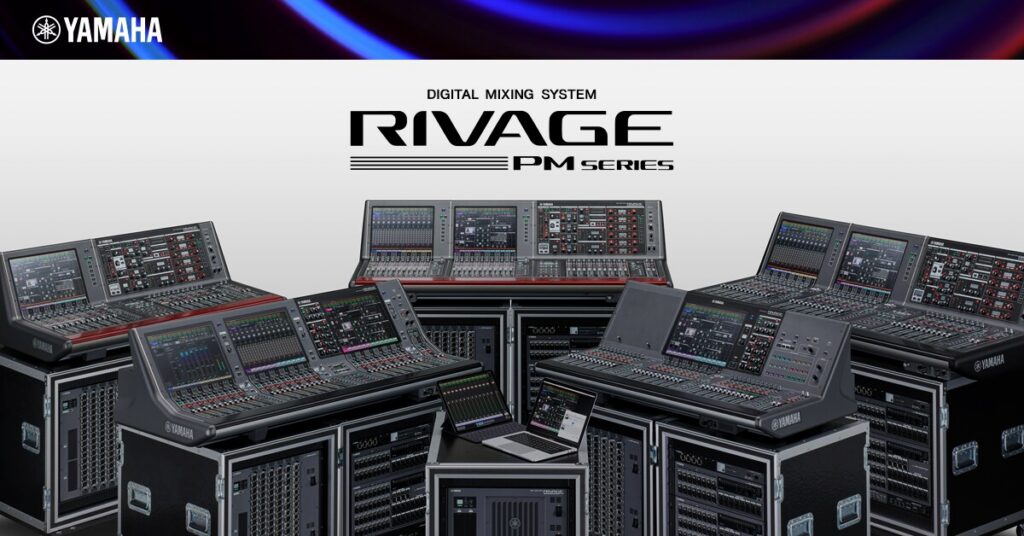
The Rivage PM line is Yamaha’s flagship for arena touring, broadcast, and large theatrical applications. The series shares a common software platform and DSP family (DSP-R10, DSP-RX and DSP-RX-EX engines, plus the PM7’s integrated CSD-R7), Rio and RPio stage I/O racks, and TWINLANe / Dante networking.
Rivage PM10 is the historical flagship — 38 fader CS-R10 surface, modular, with deep VCM (Virtual Circuitry Modeling) processing for vintage compressor and EQ emulations. The PM10 pairs the CS-R10 with the DSP-R10 engine (144 inputs, 72 mix and 36 matrix busses); complete systems with stage I/O are six-figure investments quoted by dealers.
Rivage PM7 (introduced in 2018) is an integrated console, the CSD-R7, with the engine built in: 120 inputs at launch (144 in current firmware), 60 mix busses and 24 matrices (36 today), and 38 faders in three bays of 12 plus two. PM7 is the natural choice for tours and broadcasts where PM10’s footprint is excessive but full Rivage processing is required. Pricing is configuration-dependent and quoted by dealers.
Rivage PM5 and PM3 (announced in May 2020) extend the Rivage architecture into more compact systems. PM5 uses the CS-R5 surface (three touch panels) and PM3 the CS-R3 (one touch panel, the most compact in the series); both keep three bays of 12 faders and run on the DSP-RX (120 inputs) or DSP-RX-EX (288 inputs) engines. PM5 targets touring and corporate; PM3 targets corporate AV and theatrical. Pricing is configuration-dependent.
The Rivage PM series’s distinctive technical features:
- VCM processing — Yamaha’s vintage emulation library, including Rupert Neve Designs Portico 5033 EQ, Portico 5043 compressor and SILK, plus various analog-style EQs and compressors
- TWINLANe network — Yamaha’s proprietary 400-channel optical fiber network, plus standard Dante I/O
- Stage I/O racks — TWINLANe RPio622/RPio222 modular racks and Dante Rio3224-D2/Rio1608-D2 stage boxes
- Premium rack — additional outboard-style processing on the engine for distinctive channel character
Yamaha CL and QL series
Below the Rivage flagship sits the CL and QL series — Yamaha’s upper-mid tier digital consoles, very widely deployed in installed venues, theater, churches, and mid-tier touring.
CL5 (72 mono + 8 stereo input channels, 24 mix buses, 8 matrix, 34 motorized faders) is Yamaha’s most successful pro-tier console of the last decade. CL5 is found at venues from regional theaters to mid-size arenas, on theatrical productions, and on broadcast TV music shows. Pricing depends on configuration; complete systems with Rio I/O are typically five-figure investments.
CL3 and CL1 are the smaller-format CL frames (64 and 48 mono input channels respectively, plus 8 stereo), aimed at smaller installations and touring.
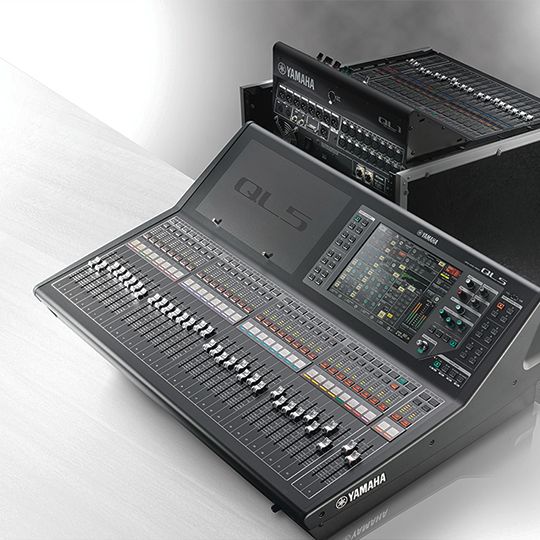
QL5 and QL1 are the simplified versions of CL with lower channel counts (64 and 32 channels) and integrated I/O alternatives. QL5 is widely used in broadcast and corporate.
CL and QL consoles share the Dante-native architecture, snapshot recall, and basic VCM library — but at significantly less DSP depth than Rivage. They’re the right specification when the application doesn’t require flagship-tier processing.
Sonic character and processing
Yamaha’s design philosophy emphasizes transparency and predictability rather than tonal character. The Rivage PM series, with its VCM processing library, gets closer to “character” sound than CL/QL — the SSL-type and Neve-type emulations are credible, particularly for live broadcast music applications.
For pure tonal warmth, Midas Pro X and DiGiCo Quantum with Mustard processing typically score higher with engineers who want analog feel from a digital console. For comparison context, see our Yamaha vs Midas Pro flagship live comparison.
Where Yamaha flagship fits in a 2026 facility
Rivage PM10/PM7 is the natural choice for:
- Major Asian broadcast networks (Yamaha’s home market)
- Large corporate AV with consistent tour-spec sound
- Installed mid-arena venues where Yamaha integration with Rio I/O is established
- Tours with mixed in-ear and FOH responsibilities (Rivage’s monitor capability is strong)
CL5/CL3 is the natural choice for:
- Regional theater touring
- House of worship at the upper-mid tier
- Mid-size corporate events
- Educational facility flagship installations
For application-specific guidance, see best digital mixing console for arena tour 2026 and our arena/festival live sound setup walkthrough.
Where to buy Yamaha flagship consoles
Yamaha pro audio consoles are widely available through Sweetwater (US), B&H Photo (US), and Thomann (EU). Sweetwater handles complete Rivage and CL systems with installation support. Thomann offers competitive EU pricing on CL/QL frames in particular. Larger Rivage installations sometimes go through Yamaha professional audio specialists or regional integrators.
Used CL5 frames trade actively on Reverb.com — the model has been in production long enough that there’s a healthy used market.
Bottom line
The Yamaha Rivage PM series is a credible flagship for touring, broadcast, and theatrical use; the CL5 in particular is one of the most successful upper-mid-tier digital consoles of the last decade. For pure character or processing depth, DiGiCo and Midas may win head-to-head, but Yamaha’s combination of reliability, mature Dante networking, and broad parts availability makes it a default choice in many segments.
For the broader context on professional mixing consoles, return to our professional mixing console 2026 expert guide.
Where to buy : Yamaha QL1
| Retailer | Why | |
|---|---|---|
| Thomann Yamaha QL1 | Reference price, 3-year warranty, pro stock in Europe | Yamaha QL1 at Thomann → |
Affiliate link: the price is the same for you, the commission funds our tests.
Read also: Solid State Logic (SSL) mixing consoles: complete guide to the SSL legacy · Neve mixing consoles: vintage and modern flagship guide
Sources — manufacturer documentation consulted for this article: Yamaha Pro Audio.
Read also: Yamaha Rivage PM5 vs PM7 vs PM10 · Yamaha CL5 discontinued: used or DM7?
→ See all our Le Fader ratings
Useful accessories for the Yamaha QL1
Gear4music / Thomann affiliate links: the price is the same for you, the commission funds our tests. Products checked on 28/09/2026; price and stock on the retailer page.
- Protection / transport : Thomann Cover Yamaha QL1
- Compatible stagebox : Yamaha Tio1608-D2
- Network cable for the stagebox : Klark Teknik Cat5e Tour-Grade (50 m)
- DI box : Radial Pro DI
- XLR cable : Studiospares Plus XLR (5 m)