
The SSL 4000 series is the most consequential mixing console family in recording history. Across roughly 1,500 units produced between 1979 and the mid-1990s, the 4000-series defined the sonic vocabulary of three decades of pop, rock, R&B, and hip-hop production. Quincy Jones produced Thriller on a 4000B at Westlake. Mutt Lange mixed Def Leppard’s Hysteria on a 4000G at Wisseloord. Madonna, Phil Collins, Whitney Houston, U2, Nirvana, and a substantial share of every major-label release between 1980 and 2005 went through SSL 4000 channel strips at some stage. By 2026, restored 4000-series frames are coveted vintage instruments, and the SSL channel strip topology lives on in 500-series modules, plugin emulations, and the modern Origin and Duality consoles.
This is the history of the SSL 4000 series, from a working pro audio perspective.
SSL 4000B: the original (1979-1982)
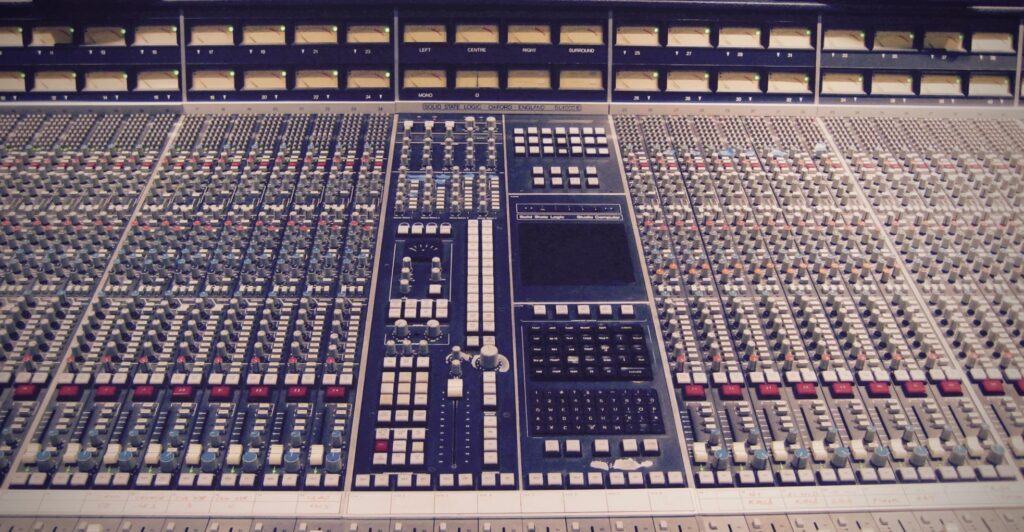
The original SSL 4000B launched in 1979 with two features that would change the industry permanently: total recall, which used a photographic system to record every knob position on the console for session reset; and the integrated Quad bus compressor on the master section, the most influential bus compressor design in pop production history.
The 4000B channel strip carried a four-band parametric EQ (the original “02 EQ”, with black knobs on early frames), a comprehensive dynamics section with separate gate and compressor, and the in-line monitoring topology that gave engineers two channels of routing per physical strip. The center section included the Quad bus compressor, master VCA fader grouping, and an extensive monitor matrix.
Major early 4000B installations included Westlake Audio (LA), Sigma Sound (Philadelphia), and the Townhouse Studios complex (London). The Westlake 4000B is the console on which Quincy Jones and Bruce Swedien recorded Thriller in 1982 — making it arguably the most documented and culturally significant individual mixing console in history.
SSL 4000E: the workhorse (1982-1987)
The SSL 4000E launched in 1982 as a progressive refinement of the 4000B. The most significant change was the introduction of the Black Knob 02 EQ as standard, with progressive refinements to the bus compressor and automation system. The 4000E became the dominant flagship at major commercial studios from 1983 through the late 1980s.
The list of records made on 4000E frames is essentially the canonical 1980s pop and rock catalog: Madonna’s Like a Virgin (Sigma Sound), Tears for Fears’ Songs from the Big Chair (The Wool Hall), Phil Collins’s No Jacket Required (Townhouse), countless Whitney Houston productions at Westlake, and a substantial share of the UK pop output of the mid-1980s.
The 4000E’s automation was Total Recall version 1, which used a photographic system: the engineer pressed a button, the console photographed every knob position, and recall meant manually setting every knob back to match the photograph. By modern standards this is primitive, but in 1982 it was revolutionary — sessions could be recalled days or weeks later, transforming the economics of mixing.
For broader context on how this fit into the 1980s flagship era, see our 1980s mixing consoles history.
SSL 4000G: the refined flagship (1987-1995)
The SSL 4000G launched in 1987 with several refinements to the 4000E architecture: the introduction of the Brown Knob 242 EQ (a smoother, more musical EQ topology that engineers describe as preferable for vocals and acoustic sources), enhanced bus compressor with switchable detection options, and a more sophisticated automation system using the G+ Computer with proper data-based recall (no more photographs).
The 4000G became the standard flagship at major commercial studios from 1988 through the mid-1990s, and remained in active service at most installations well into the 2000s. The list of 4000G records includes Pearl Jam’s Ten, Nirvana’s Nevermind basic tracks (the album was recorded primarily at Sound City but with significant 4000G mixing at other studios), and countless major-label productions of the early-to-mid 1990s.
A meaningful refinement happened with the 4000G+ designation introduced around 1990, which integrated automation refinements and progressive electrical updates. By the time production wound down in the mid-1990s, 4000G+ was the canonical “best” version of the 4000-series for most engineers.
The 4000-series sonic signature
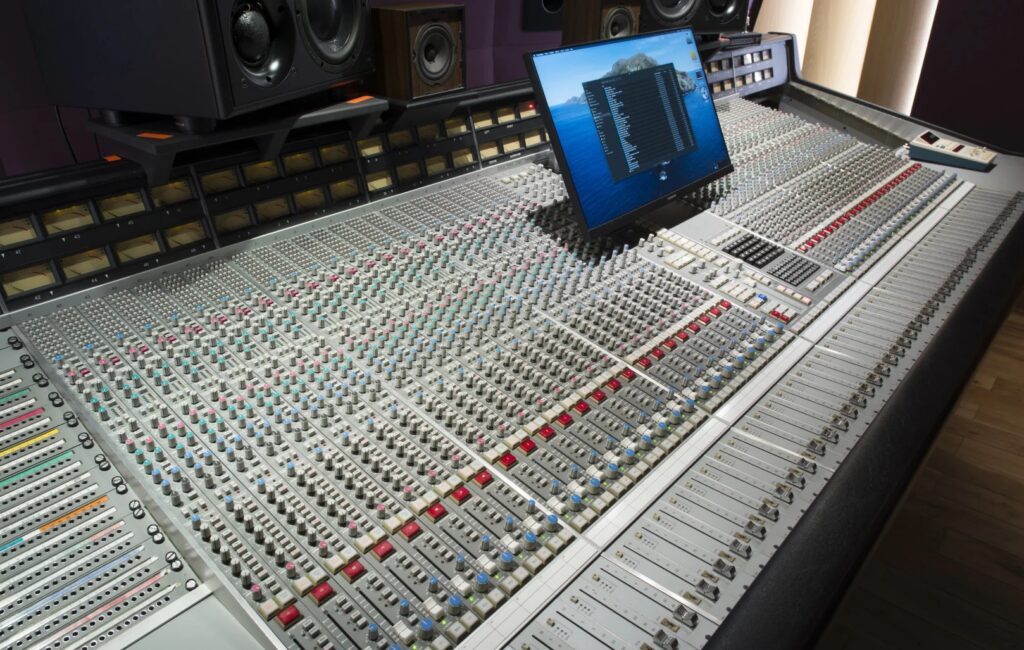
What does an SSL 4000 sound like? Several characteristics define the signature:
1. The bus compressor. The Quad bus compressor on the master section produces a fast, glued-together master bus regardless of program material. The compressor’s specific attack and release behavior — particularly the option settings on the 4000E and 4000G+ — became the de facto reference for “modern pop bus compression”. Plugin emulations (Waves SSL Bus Compressor, UAD SSL 4000G, and dozens of others) attempt to reproduce this character.
2. The channel strip EQ. The Black Knob 02 (4000B/E) versus Brown Knob 242 (4000G/G+) distinction is well-known among engineers. The 02 is more aggressive, with audible phase behavior at extreme settings — well-suited to drum and percussion work. The 242 is smoother and more linear-phase-like at moderate settings — better for vocals and acoustic sources.
3. The dynamics section. The integrated channel-strip compressor on the 4000-series uses a fast attack and a particular release behavior that engineers describe as “punchy” or “in-your-face”. This is distinct from the bus compressor and contributes meaningfully to the SSL character.
4. The summing topology. SSL summing (using IC op-amps with active mixing topology) is cleaner and more transparent than Neve transformer summing, but contributes less harmonic enhancement. This is why engineers often describe SSL as “cleaner” and Neve as “warmer”.
For broader context, see our SSL vs Neve comparison and Solid State Logic SSL mixing consoles guide.
The 4000-series market in 2026
By 2026, the 4000-series vintage market is mature and active:
- 4000B frames — rare, with most surviving examples in major studios that don’t sell. Restored 4000B frames trade at 100,000-180,000 USD when available.
- 4000E frames — more common, restored frames trade at 70,000-130,000 USD depending on size (typically 32-48 channels) and condition.
- 4000G and 4000G+ frames — the most common 4000-series on the used market, restored frames trade at 80,000-180,000 USD depending on size (32-72 channels) and whether automation has been updated to current SSL UF8 control or kept original.
The cost of full 4000-series restoration — capacitor replacement, fader reconditioning, automation system updates — typically runs 50,000-100,000 USD on top of purchase price. Specialist firms include Funky Junk (UK) and Vintage King Audio’s restoration team (US).
For comprehensive guidance, see our vintage mixing console restoration guide and pro mixing console maintenance guide.
Where 4000-series consoles fit in 2026
A vintage SSL 4000G is the right specification for:
- Commercial recording studios targeting major-label clients who specifically request the SSL sound
- Pop, R&B, and hip-hop production rooms (genres that the 4000-series defined sonically)
- Studios with established technical staff capable of long-term maintenance
- Heritage production environments where the SSL legacy is part of the studio’s identity
For application context, see best high-end mixing console for pro studio 2026 and flagship recording studio setup.
Bottom line
The SSL 4000 series is the most consequential mixing console family in recording history. The 4000B introduced the architectural vocabulary; the 4000E made it the industry standard; the 4000G refined it to maturity. In 2026, restored 4000-series frames remain world-class instruments — and the SSL channel strip topology continues to define what “modern pop production” sounds like.
For the broader context on professional mixing consoles, return to our professional mixing console 2026 expert guide.
Read also: Vintage mixing console restoration guide: complete pro overview · 1980s mixing consoles: history of the iconic flagship era
Sources — manufacturer documentation consulted for this article: Solid State Logic.
🎚️ Essential accessories for your mixing console
As an Amazon Associate I earn from qualifying purchases.