
The 1980s were the most consequential decade in mixing console history. Between 1980 and 1989, virtually every console architecture and feature set that defines modern pro audio was either introduced or perfected: total recall automation, in-line monitoring, integrated bus compression, large-frame VCA grouping, and the standardization of 24-track production. The flagship consoles of this decade — the SSL 4000E and 4000G, the Neve V series and VR, the Harrison 32-series, the MCI JH-600, and digital multitracks such as Sony’s PCM-3324 and Mitsubishi’s X-850 — recorded a substantial share of the most commercially successful and artistically influential music ever produced. Many of these consoles remain in active service in 2026, and the design vocabulary they established still defines how engineers approach mixing.
This is the story of the 1980s flagship console era, from a working pro audio perspective.
The pre-1980s context
To understand why the 1980s consoles mattered, it helps to recall what came before. The 1970s flagship consoles — the Neve 8068, 8078, 8088, the early SSL frames, MCI JH-500, Cadac, Trident A-Range — were largely hand-built and mostly operated manually. Automation was in its infancy — MCI’s JH-500 (1975) offered VCA automation and Neve’s NECAM moving-fader system arrived in the late 1970s — but it was far from universal. Recall meant photographs and detailed notes. Sessions ran long, with engineers physically holding fader rides through entire songs, often with multiple assistants. Production was an athletic event.
The 1980s solved this — not by replacing analog signal path (which remained analog throughout the decade) but by automating it.
SSL 4000: the console that changed everything
The Solid State Logic 4000B arrived in 1976 with an integrated computer; the SSL 4000E followed in 1979, with the now-iconic bus compressor on the master section, and Total Recall (1981) stored every knob position so a session could be reset by hand. The E’s original “brown knob” EQ was joined in 1983 by the “black knob” 242 EQ developed with George Martin for AIR; in 1987 the SSL 4000G brought a revised G-series EQ and automation refinements. Studios that installed SSL 4000s in the early-to-mid 1980s could mix sessions in a fraction of the time required on legacy consoles, and could recall sessions weeks or months later for revisions.
The list of records made on SSL 4000s in the 1980s is the canonical list of 1980s pop and rock production: Madonna’s Like a Virgin (a 48-input SSL E Series at the Power Station, New York), Hugh Padgham’s gated drum sound at London’s Townhouse — found through the SSL’s heavily compressed talkback listen mic and made famous on Phil Collins’ “In the Air Tonight” (1981) — and countless UK pop productions at Sarm West and Townhouse. (Not every landmark record was SSL, though: Thriller was recorded on a Harrison 32C at Westlake.) The SSL 4000 didn’t just record the 1980s — it shaped the sonic vocabulary of the entire decade.
For deep history of the SSL 4000 series specifically, see our SSL 4000 series history article.
Neve V series: the 1980s Neve
The Neve V series (V1, V2, V3) launched in 1985 as Neve’s response to SSL’s automation revolution (the first frame went to Yellow 2 in Stockport, the second to AIR Studios in London). Where the legacy 80-series Neves had been transformer-coupled Class A discrete tracking consoles without automation, the V series brought Neve sonic character into a fully automated, recall-capable, larger-format frame. The V3, released in 1987, became a flagship at major studios through the late 1980s and into the 1990s.
The V series sat alongside the SSL 4000G as the two dominant 1980s flagships, with engineers and studios choosing between them based on sonic preference: SSL for tight, punchy, modern productions; Neve V for warmth and harmonic richness.
The V series evolved into the Neve VR series in 1988 (with the VR Legend following in 1991), which carried the V’s basic architecture into the 1990s with progressive refinements. For deeper history, see our Neve VR vintage flagship history article.
API Legacy and Trident A-Range: the alternatives
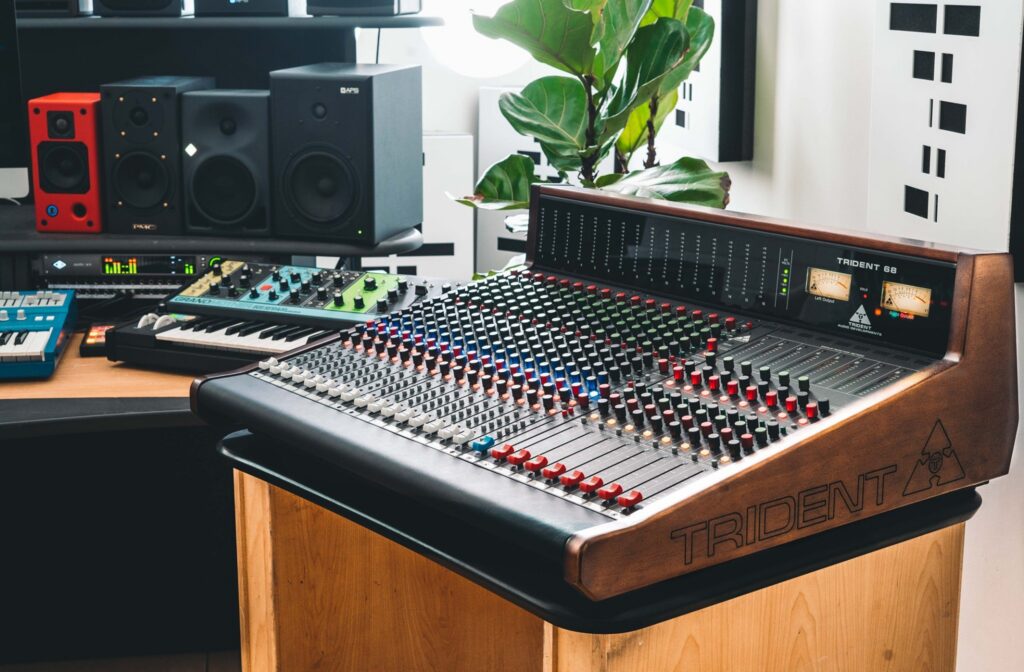
Several other consoles — some older, some newer — are often discussed alongside the SSL/Neve duopoly:
API Legacy is in fact a 1990s design — API changed hands in 1978 and 1985, and the first full Legacy was installed at Greene Street Recording in New York in 1992 — but it carried forward the API sound favoured by studios specializing in American rock and rhythm-driven production. The API discrete topology — 2520 op-amps, output transformers, proportional-Q EQ — produced a brighter, more aggressive sound than either SSL or Neve. Earlier API consoles remained in service through the 1980s at studios such as the Record Plant in Sausalito, where Fleetwood Mac’s Rumours had been tracked on an API desk in 1976.
Trident A-Range (designed in the early 1970s; only 13 were built) was the British alternative — a transformer-coupled console with a distinctive EQ topology that engineers describe as exceptionally musical. The A-Range is associated with 1970s sessions at Trident Studios, including early Queen albums; surviving frames are now extremely valuable on the vintage market.
MCI JH-600 and JH-636 were US-built flagships popular at US commercial studios. MCI was acquired by Sony in 1982 and the consoles continued in production through the late 1980s.
Digital multitrack recorders — Sony’s DASH machines such as the PCM-3324 and Mitsubishi’s ProDigi X-850 32-track (the X-86 was a two-track model) — introduced digital recording at flagship studios, though the consoles themselves remained analog through the 1980s.
What 1980s consoles had in common
Despite different sonic signatures, the 1980s flagships shared several architectural commitments that defined the era:
1. In-line monitoring. Each channel strip carried two signal paths — a tape input for tracking and a separate monitor return — allowing the engineer to monitor and process tracking signals without disrupting the recording chain. This architecture, pioneered by MCI’s JH-400 in 1972 and adopted across the industry (including by SSL), made 24-track production manageable.
2. VCA fader grouping. Voltage-controlled amplifier (VCA) grouping let engineers control multiple physical faders from a single master fader. Drum buses, vocal stacks, and orchestral sections could be ridden as a unit. For more on this, see our VCA vs DCA explained.
3. Total recall. Whether implemented via SSL’s Total Recall computer system or competitor approaches, the ability to recall a session days or weeks later changed the economics of mixing.
4. Analog signal path. The 1980s consoles were not yet digital. Neve retained discrete, transformer-coupled designs, while SSL and MCI relied largely on IC op-amps with transformer or electronic balancing at strategic points. The character of these consoles came from these analog topologies.
For broader signal flow context, see mixing console signal flow pro explained.
Where 1980s consoles fit in 2026
A substantial share of 1980s flagship consoles remain in active service in 2026. SSL 4000-series frames at many commercial studios still record sessions. Neve V series frames continue to operate at facilities that have invested in long-term maintenance. Vintage API consoles remain at studios specializing in heritage rock production.
For studios considering a vintage 1980s console acquisition, the relevant context includes:
- Annual maintenance budgets of 8,000-20,000 USD for active operation
- Capacitor replacement every 15-25 years (typically 30,000-80,000 USD per recap cycle)
- Fader reconditioning requirements
- Insurance and parts availability considerations
For comprehensive guidance, see our vintage mixing console restoration guide and pro mixing console maintenance guide.
Bottom line
The 1980s established the architectural and operational vocabulary of modern mixing consoles. The SSL 4000E and 4000G, the Neve V series and VR, and the era’s other flagships remain reference points against which every modern flagship is implicitly measured. Many of these consoles continue to deliver world-class sound in 2026 — for studios able to maintain them, a 1980s flagship is a uniquely valuable instrument.
For the broader context on professional mixing consoles, return to our professional mixing console 2026 expert guide.
Read also: SSL 4000 series history: the console that defined modern records · Vintage mixing console restoration guide: complete pro overview
Read also: Legendary consoles behind legendary records · SSL 9000 J and XL 9000 K
Useful accessories
Gear4music / Thomann affiliate links: the price is the same for you, the commission funds our tests. Products checked on 28/09/2026; price and stock on the retailer page.
- Monitoring headphones : Audio-Technica ATH-M50x
- DI box : Radial Pro DI
- XLR cable : Studiospares Plus XLR (5 m)
- Monitoring headphones : beyerdynamic DT 770 Pro (250 ohms)