
Automated Processes Inc. — known universally as API — has occupied a specific and durable niche in pro audio since the late 1960s. Founded in 1968 by Saul Walker and Lou Lindauer, API built its reputation on discrete operational amplifiers (the 2520 op-amp, still in production), Class A circuit topology, and a punchy, fast-attacking sound that became synonymous with American rock and rhythm-driven music. Where Neve sounds warm and SSL sounds glued, API sounds aggressive — front-of-the-mix, with transient detail that cuts through dense arrangements without EQ assistance.
This guide covers the modern API console line: the 1608-II, 2448, Vision, and Legacy AXS, plus the rationale for choosing API over the British alternatives.
API 1608-II: the modern small-format flagship
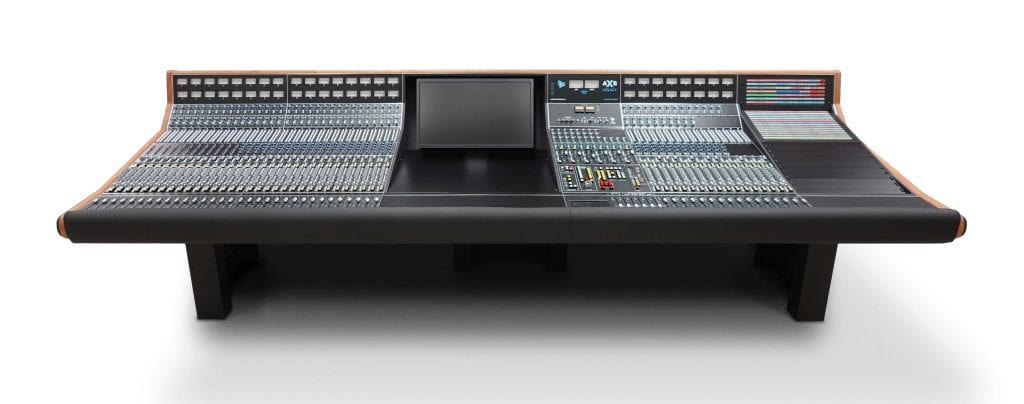
The API 1608-II (16, 32, or 48 channels; API list prices from around 54,000 USD for 16 channels to around 146,000 USD for 48 channels, more with Final Touch automation) is API’s modern recording console. Each channel carries an API EQ — a standard 16-channel bucket ships with twelve 550A three-band and four 560 ten-band graphic EQs (the same circuits found in API’s 500-series modules) — API’s discrete mic preamp with the 312 topology, and routing to up to eight buses plus stereo. The 1608-II is built around the 2520 discrete op-amp throughout the signal path, with API output transformers and Class A summing.
The 1608-II is the natural choice for high-end commercial studios that want the API sound at a sub-150K budget. Compared to a SSL Origin at similar pricing, the API delivers more aggressive transient response and a noticeably more present upper midrange — the trade-off is a less polished bus compressor (a stereo bus compressor is not part of the 1608-II’s standard configuration) and a more colored, less neutral signal path.
API 2448 and API The Box: project-scale API
The API 2448 (24, 32 or 40 channels; around 106,000 USD for 24 channels with automation at US retail) is API’s dual-path in-line console, aimed at mid-sized commercial rooms. It shares the 1608-II’s circuitry but adds a second signal path per channel for simultaneous tracking and monitoring.
API The Box (in its current form, eight input channels with mic preamps, eight 500-series slots and 24 channels of summing at mixdown) is API’s small-format console — an analog signal path designed around DAW-based production. Aimed at producer-engineers and mid-level commercial rooms, it’s the most accessible entry into the API ecosystem in 2026. Note that “accessible” here means in the context of pro audio — The Box is still firmly in the professional tier.
API Vision: the large-format console
API Vision (large-format, with pricing well into six figures) is API’s flagship surround recording and mixing console. Introduced after Audio Toys acquired API in 1999 — before the 1608 existed — Vision uses API’s discrete topology with dual inputs, two moving faders per channel and surround panning on every fader. Vision installations include several major commercial facilities in Nashville, LA, and New York.
Vision competes directly with the AMS Neve 88R and SSL Duality δelta at the upper end of the analog flagship segment. The choice between them is essentially a sonic preference — API is brighter and more aggressive, Neve is warmer and harmonically richer, SSL is the cleanest of the three.
API Legacy AXS and Legacy Plus: large-format heritage
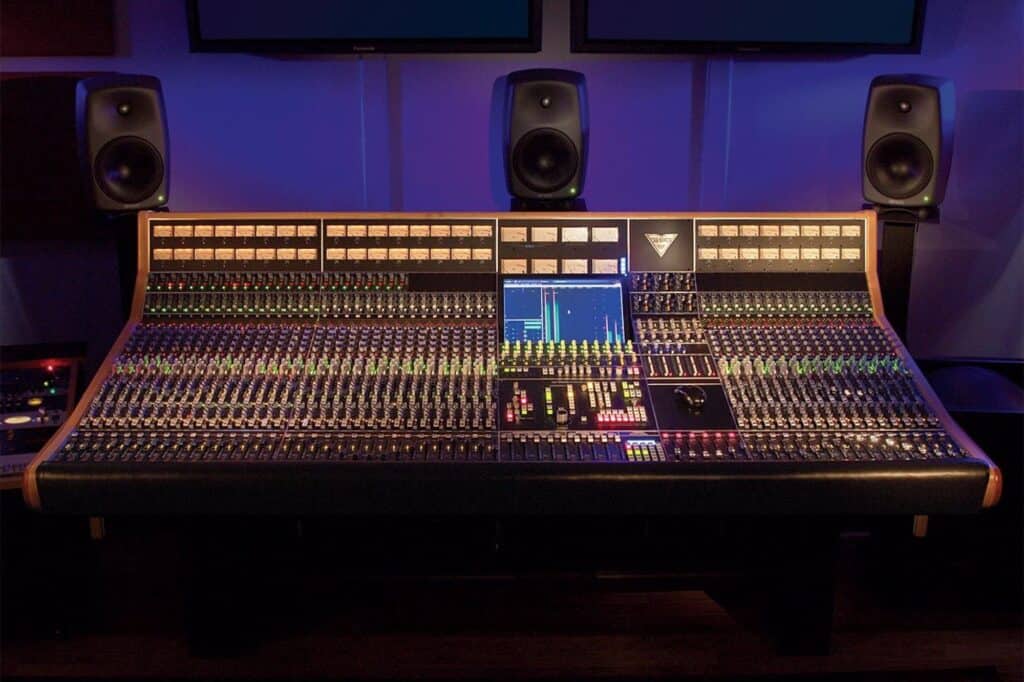
The Legacy AXS and Legacy Plus are large-format heritage frames — the AXS runs from 32 to 80 channels in 16-channel buckets and is an in-line design, with dual inputs per channel (100mm main fader plus a second fader), 24 buses, surround monitoring, Final Touch automation and an onboard 2500C stereo bus compressor. These are specified by major commercial studios that want a large-format tracking and mixing console. Pricing depends heavily on configuration and runs well into six figures.
Sonic character: what makes API sound like API?
The API signature comes from three converging factors: the 2520 discrete op-amp (which has higher slew rate and harder clipping behavior than typical IC op-amps), the API output transformer (which adds harmonic content and a particular saturation under hot signals), and the proportional-Q EQ in the 550A and 560 modules (which becomes more selective as you boost or cut, unlike constant-Q designs).
The result is a console that excels on aggressive material — rock drums, electric guitars, brass, percussion — and is widely considered less ideal for orchestral or acoustic-classical work, where Neve or Studer offer a more transparent treatment.
For a deeper analog vs digital perspective, see our digital vs analog pro mixing console comparison.
Where API fits in a 2026 facility
API is the natural choice for commercial recording studios specializing in rock, pop, hip-hop production, and any music style that benefits from front-of-the-mix transient detail. Major US studios with API installations include Blackbird in Nashville, whose Studio D houses a 96-channel API console.
The 1608-II (installed in over 600 studios across its two versions) is the most popular configuration; Vision is for flagship-tier rooms. The Box is the entry point and a credible choice for high-end producer rooms running hybrid workflows.
For long-term ownership considerations, see our pro mixing console maintenance guide. API consoles are generally robust — discrete circuitry is more serviceable than IC-based topology, and 2520 op-amps remain in current production.
Where to buy API consoles
New API consoles are available from Sweetwater (US), Vintage King Audio (US, specialist installations), and API’s authorized international dealers. Used Legacy AXS and 1608-II frames occasionally appear on Reverb.com and Vintage King Audio’s certified used catalog.
Bottom line
API offers a sonic philosophy — aggressive, fast, discrete — that no other analog console fully replicates. The 1608-II is the workhorse of the modern lineup; Vision is the flagship; Legacy is for heritage tracking applications. For studios committed to American rock, pop, and rhythm-section production, API is often the right answer.
For the broader context on professional mixing consoles, return to our professional mixing console 2026 expert guide.
Where to buy : API Vision
| Retailer | Why | |
|---|---|---|
| Gear4music | Reference price, 3-year warranty, pro stock in Europe | See analogue mixers at Gear4music → |
Affiliate link: the price is the same for you, the commission funds our tests.
Sources — manufacturer documentation consulted for this article: API.
Read also: SSL vs Neve vs API · Legendary consoles behind legendary records
→ See all our Le Fader ratings
Useful accessories
Gear4music / Thomann affiliate links: the price is the same for you, the commission funds our tests. Products checked on 28/09/2026; price and stock on the retailer page.
- Monitoring headphones : Audio-Technica ATH-M50x
- DI box : Radial Pro DI
- XLR cable : Studiospares Plus XLR (5 m)
- Monitoring headphones : beyerdynamic DT 770 Pro (250 ohms)