
In the upper-mid tier of professional live sound, the choice between Yamaha Rivage PM and Midas Pro X / Heritage 3000 is one of the most contested specifications in touring and installed venue applications. Both manufacturers have decades of pro live sound experience, both are owned by major audio conglomerates (Yamaha is Yamaha; Midas is part of the Music Tribe / Behringer group), and both offer mature flagship consoles at competitive price points. But they target different sonic philosophies and different operator profiles — a fact that’s frequently obscured by superficial spec-sheet comparisons.
This guide compares the Yamaha and Midas flagships head-to-head from a working live sound engineer’s perspective.
The fundamental sonic difference
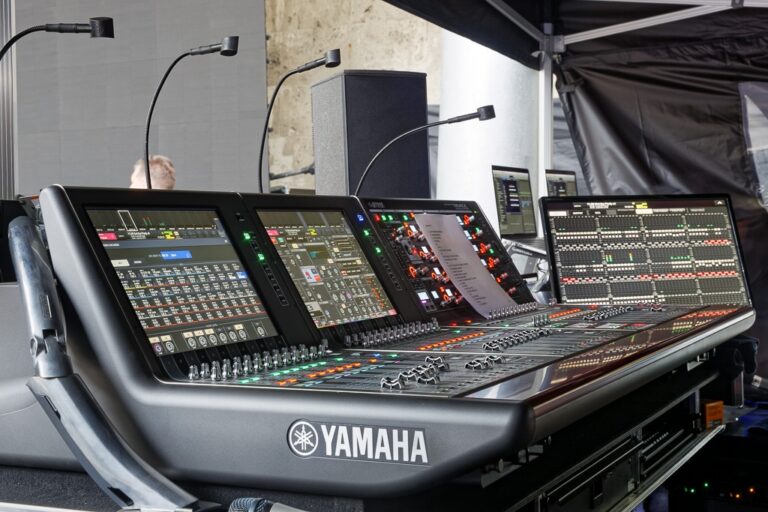
The most important difference between Yamaha Rivage and Midas Pro is sonic philosophy:
Yamaha Rivage targets transparency and predictability. The default signal path is clean, with VCM (Virtual Circuitry Modeling) processing available as opt-in vintage character emulation. Engineers who want analog warmth on Yamaha typically activate VCM modules selectively — Rupert Neve Designs Portico II emulation, SSL E-channel-type EQ, vintage compressor models. The console doesn’t impose tonal character; the engineer chooses when and where to add it.
Midas Pro X targets analog character by default. The Heritage processing engine — shared between Pro X and Heritage 3000 — emulates the sonic behavior of the legacy XL series analog consoles. The default sound has a warmth in the lower midrange and a softer high frequency response that engineers describe as “analog feel” or “musical”. Engineers who want transparency on Midas have to work against the default character, not toward it.
For broadcast music, theatrical, and corporate AV applications where consistency between live sound and studio recording matters, Yamaha’s transparent default is operationally advantageous. For rock, country, heritage pop, and singer-songwriter touring where analog character is the explicit specification, Midas typically wins.
Channel count and processing
Yamaha Rivage PM10 / PM7:
- 144 input channels processable at 96 kHz (PM10), 96 channels (PM7)
- 72 mix buses + 24 matrix outputs
- DSP-RX or DSP-RX-EX engine
- VCM library (vintage compressor and EQ emulations)
- TWINLANe + Dante networking
- 38-fader surface (PM10) or 24+12+2 fader surface (PM7)
Midas Pro X / Heritage 3000:
- 96 input channels processable at 96 kHz
- 35 output buses + matrix
- Heritage 3000 processing engine
- Built-in vintage character (no opt-in needed)
- AES50 networking with DL-series stage I/O
- 28-fader surface (Pro X), 31+13 fader surface (Heritage 3000)
For raw channel count, Yamaha PM10 wins (144 vs 96). For processing per channel, both are class-leading at the flagship tier; Yamaha has more comprehensive VCM library, Midas has richer default analog character without configuration effort.
Networking comparison
Yamaha TWINLANe + Dante:
- TWINLANe is Yamaha’s proprietary 400-channel optical fiber network (legacy, being phased toward Dante in newer Rivage installations)
- Dante is the universal modern audio network — interoperable with most other manufacturers
- Rio stage I/O racks (Rio3224-D2, Rio1608-D2) provide modular 64×64 I/O
- Excellent integration with non-Yamaha gear via Dante
Midas AES50:
- AES50 is the proprietary low-latency network shared with Behringer X32 and Klark Teknik DL-series racks
- Excellent within the Music Tribe ecosystem (Midas, Behringer, Klark Teknik, Lake)
- Limited interoperability with non-Music Tribe systems without bridge devices
- Mature and reliable, but less universal than Dante
For installations requiring integration with diverse third-party gear, Yamaha’s Dante-native architecture is operationally simpler. For self-contained Midas/Behringer ecosystems, AES50 is mature and reliable.
Operational ergonomics
Yamaha Rivage workflow:
- Larger surfaces with more dedicated controls per channel strip
- Comprehensive Selected Channel section (similar to a large-format analog console)
- TouchPanel integration for advanced routing and snapshot management
- Multi-engineer split modes for FOH/monitor sharing
Midas Pro workflow:
- More compact surfaces with combined display sections
- POPulation groups for dynamic VCA-style fader grouping
- “Look and feel” of an analog console (intentional design choice)
- Slightly steeper learning curve for engineers without analog console background
Both are professional-grade ergonomics. The choice often depends on engineer preference and prior training.
Pricing comparison
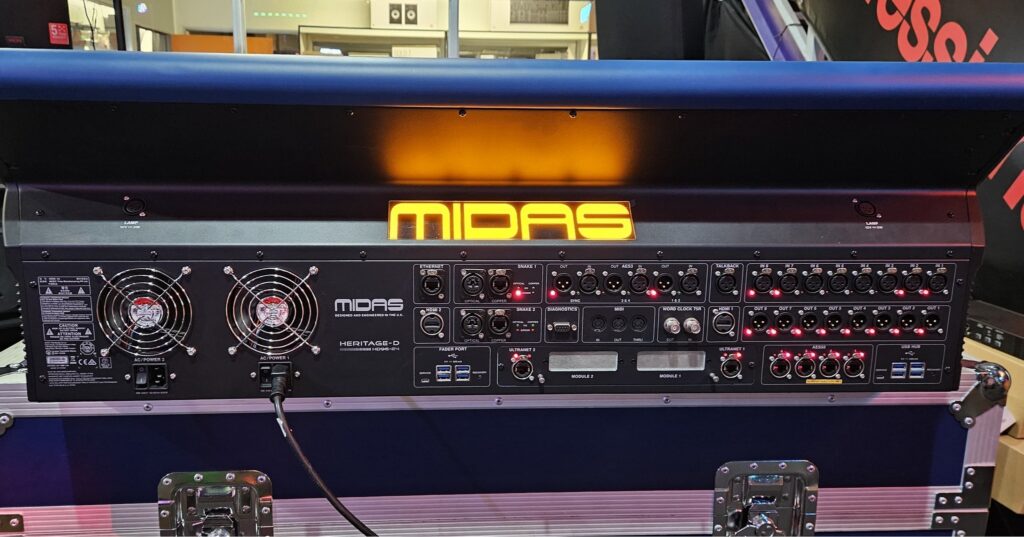
For comparable system configurations:
Yamaha Rivage PM10 system (CS-R10 surface + DSP-RX engine + 2x Rio3224-D2): typically 180,000-260,000 USD.
Yamaha Rivage PM7 system (CS-R7 surface + DSP-RX engine + 2x Rio3224-D2): typically 110,000-160,000 USD.
Midas Pro X system (Pro X surface + 2x DL231 stage I/O + AES50 network): typically 65,000-100,000 USD.
Midas Heritage 3000 system (Heritage 3000 surface + DL stage I/O): typically 90,000-130,000 USD.
For comparable processing depth and channel count, Midas is meaningfully more affordable than Yamaha Rivage PM. This pricing differential is one of the most significant practical considerations when choosing between the two brands — Midas Pro X delivers flagship live sound at roughly 60-70% of comparable Yamaha pricing.
Application fit
Yamaha Rivage PM dominates:
- Asian broadcast and touring markets (Yamaha’s home territory)
- Large corporate AV with consistent tour-spec sound
- Installed mid-arena venues where Yamaha integration with Rio I/O is established
- Theater and orchestral live sound applications
- Tours with mixed in-ear and FOH responsibilities (Rivage’s monitor capability is class-leading)
For application context, see best digital mixing console for arena tour 2026 and arena/festival live sound setup walkthrough.
Midas Pro X / Heritage 3000 dominates:
- Heritage rock and singer-songwriter touring
- Country music touring (where analog warmth on vocals and acoustic instruments matters)
- Mid-tier festival main stages where character is the differentiator
- Houses of worship with traditional music programs
- Theater productions with character-focused musical content
What about competitors?
Both Yamaha and Midas face competition at the flagship live sound tier:
- DiGiCo Quantum 7 — the dominant flagship for major arena tours, with deeper processing and routing flexibility than either Yamaha PM10 or Midas Pro X but at higher price point
- Avid VENUE S6L — the standard for Pro Tools-integrated applications (broadcast music, award shows, Broadway)
- SSL System T / SSL Live — gaining ground at the flagship tier with strong broadcast and touring deployments
For the most direct head-to-head with the dominant touring flagship, see DiGiCo vs Avid VENUE comparison.
How to choose
Choose Yamaha Rivage PM when:
- You want a transparent, predictable signal path with opt-in character
- Your application is broadcast, theatrical, or corporate where consistency matters
- You need maximum channel count and processing depth at the flagship tier
- Dante interoperability with diverse third-party gear is operationally important
- You’re working in Asian markets where Yamaha is the incumbent specification
Choose Midas Pro X / Heritage 3000 when:
- You want analog character as the default sound
- Your application is rock, country, heritage pop, or singer-songwriter
- Budget consciousness matters (Midas at 60-70% of comparable Yamaha pricing)
- You’re working within the Music Tribe ecosystem (Midas + Behringer + Klark Teknik + Lake)
- Your engineer has analog console training or wants an “analog feel” digital console
Bottom line
Yamaha Rivage PM and Midas Pro X / Heritage 3000 represent two valid approaches to flagship digital live sound. Yamaha is the transparent, predictable, operationally rich choice; Midas is the character-driven, more affordable, “analog feel” choice. Neither is objectively superior — the right answer depends on what you’re mixing, who your audience is, and how you want the console to sound by default.
For the broader context on professional mixing consoles, return to our professional mixing console 2026 expert guide.
Where to buy : Yamaha Rivage PM7
| Retailer | Why | |
|---|---|---|
| Thomann | Reference price, 3-year warranty, pro stock in Europe | Check price at Thomann → |
| Amazon | Fast shipping, used and renewed units | See on Amazon → |
Affiliate links: the price is the same for you, the commission funds our tests. As an Amazon Associate we earn from qualifying purchases.
Sources — manufacturer documentation consulted for this article: Midas, Yamaha Pro Audio.
→ See all our Le Fader ratings
🎚️ Essential accessories for your mixing console
As an Amazon Associate I earn from qualifying purchases.