
Calrec Audio has been the UK broadcast console standard since the 1970s. Founded in 1964 in Hebden Bridge, Yorkshire, Calrec built its initial reputation supplying the BBC with custom broadcast consoles. By the 1990s, Calrec had expanded into commercial UK broadcasting (ITV, Sky Sports, BT Sport) and major sports broadcast worldwide. In 2026, Calrec consoles handle a substantial share of the world’s largest sports broadcasts — Premier League football, Six Nations rugby, Wimbledon, the Olympics, NFL coverage on NBC and CBS, and countless other major productions. Owned by US media company Audiotonix since 2020, Calrec continues to develop the Apollo, Summa, Brio, Argo, and Type R lines.
This guide covers the modern Calrec line from a professional broadcast engineer’s perspective.
Calrec Apollo Plus: the flagship
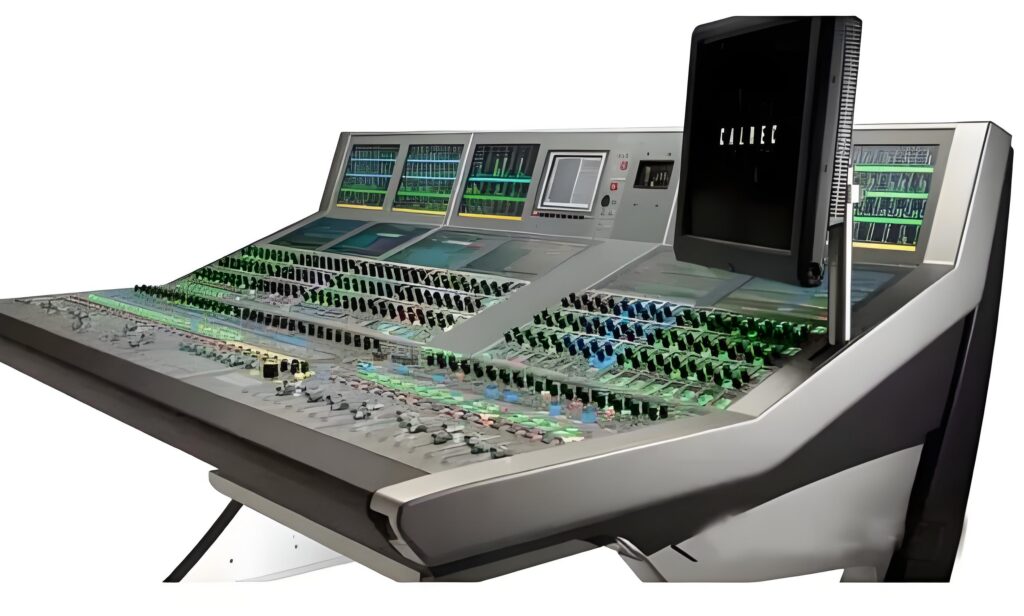
Apollo Plus is Calrec’s flagship console — up to 1,020 input channels, up to 256 faders, and the Hydra2 networking system. Apollo Plus installations are found at the largest broadcast facilities and OB trucks worldwide, particularly for major sports broadcast where its routing scale and reliability are critical. Pricing is project-specific but typically begins at 500,000 USD for compact configurations and scales to 2 million USD or more for fully loaded major-broadcaster installations.
The defining technical features:
- Hydra2 networking — Calrec’s proprietary fiber-based audio network with up to 8,192 inputs and outputs across the fabric, with 32 fully redundant connection paths
- Bluefin DSP engine — high-channel-count processing with the headroom for very large broadcast applications
- Direct-bus matrix — every input can route directly to any matrix or aux without intermediate patching
- Surround monitoring — 5.1, 7.1, and Dolby Atmos / 7.1.4 monitoring built into the master section
Calrec Summa, Brio, and Type R
Summa is the mid-tier Calrec console — 16 to 96 faders, up to 256 input channels, Hydra2 native. Summa is widely deployed in mid-size TV studios, regional broadcast facilities, and OB trucks where Apollo Plus’s footprint and cost are excessive but full Hydra2 integration is required. Pricing 200,000 to 400,000 USD.
Brio is the compact Calrec — 36 faders fixed surface, integrated I/O, designed for smaller broadcast applications (regional radio, small TV studios, university broadcast, corporate). Brio is the most accessible entry into the Calrec ecosystem at 50,000 to 80,000 USD.
Type R (introduced 2018, evolving in 2024-2025) is Calrec’s IP-native console — fully ST 2110-compliant, with a touchscreen-first surface approach designed for radio and TV applications where the operator workflow is largely software-driven. Type R competes with Lawo mc² 36 for new IP-native installations.
Argo is Calrec’s newest flagship-tier IP-native console (introduced 2022), positioned as the ST 2110 successor to Apollo for new builds. Argo combines Hydra2 ImPulse processing with native IP networking. Pricing for Argo systems begins around 350,000 USD.
What makes Calrec distinct
Several factors explain Calrec’s dominance in the highest-stakes broadcast applications:
1. Sports broadcast specialization. Calrec consoles are designed around the specific demands of multi-feed sports broadcast — multiple concurrent program feeds (international, host broadcast, world feed, talent isolation), large numbers of intercom channels, and the need for bulletproof reliability under high-pressure live conditions. The direct-bus matrix and Hydra2 routing scale are specifically suited to these applications.
2. Hydra2 reliability. Hydra2 is widely regarded as the most reliable proprietary broadcast network in production. Calrec engineers cite Hydra2’s automatic failover and dual-redundant fiber paths as a primary reason for choosing the system on major sports broadcasts where any audio dropout would be catastrophic.
3. Operator ergonomics. Calrec surfaces are designed for fast, eyes-up operation in broadcast environments. Channel strips have a consistent layout across the product line; operators trained on a Brio can transition to an Apollo Plus with minimal retraining.
4. UK broadcast incumbency. For UK-based broadcast operations and UK-trained engineers, Calrec is the default specification. This creates a self-reinforcing cycle in which UK broadcast facilities continue to specify Calrec to maintain workforce continuity.
For broader broadcast routing context, see our multi-format routing for broadcast mixing consoles guide.
Calrec vs Studer vs Lawo
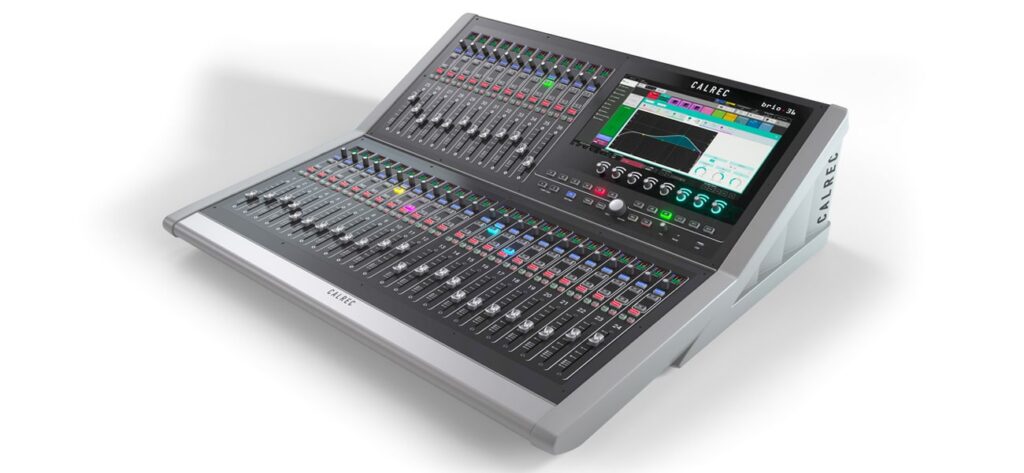
Among the three European broadcast specialists, the choice typically comes down to:
- Calrec — the right answer for major sports broadcast, UK-incumbent facilities, and applications requiring the largest channel counts with bulletproof reliability
- Lawo mc² — the right answer for new IP-native installations, German-speaking territories, and integrated audio/video workflows
- Studer Vista — the right answer for European public broadcast incumbency, post-production, and applications where the Vistonics interface is preferred
For US broadcast, Avid VENUE S6L and Yamaha Rivage hold larger shares — but Calrec has gained ground at the highest-stakes sports broadcasts (NFL, NBA, MLB major productions).
Where Calrec fits in a 2026 facility
Calrec is the natural specification for:
- Major sports broadcast OB trucks (NFL, Premier League, Champions League, Olympics, World Cup)
- UK broadcast facilities at every scale (BBC, Sky, ITV, BT Sport)
- Large international broadcast operations (multiple language feeds, world feed production)
- Music and entertainment broadcast where reliability is paramount
For application context, see best mixing console for broadcast TV/radio 2026 and broadcast TV/radio setup walkthrough.
Where to buy Calrec consoles
Calrec systems are sold primarily through factory direct (Calrec UK) and authorized broadcast integrators. Thomann (EU) and Sweetwater (US) handle smaller Brio and Type R configurations. Major Apollo Plus, Summa, and Argo installations go through Calrec’s regional offices (Calrec North America in particular) with custom integration and on-site commissioning. For UK broadcast specifically, Calrec maintains direct relationships with virtually every major broadcaster.
Bottom line
Calrec remains the broadcast console of choice for the world’s most demanding sports and entertainment broadcasts. Apollo Plus is the flagship; Argo is the IP-native flagship for new builds; Summa and Brio cover the mid and compact tiers. For UK broadcast and major sports productions, Calrec is often the only correct answer.
For the broader context on professional mixing consoles, return to our professional mixing console 2026 expert guide.
Where to buy : Calrec Aria
| Retailer | Why | |
|---|---|---|
| Thomann | Reference price, 3-year warranty, pro stock in Europe | Check price at Thomann → |
| Amazon | Fast shipping, used and renewed units | See on Amazon → |
Affiliate links: the price is the same for you, the commission funds our tests. As an Amazon Associate we earn from qualifying purchases.
Read also: Lawo mc² IP-native broadcast consoles: complete pro guide
Sources — manufacturer documentation consulted for this article: Calrec.
→ See all our Le Fader ratings
🎚️ Essential accessories for your mixing console
As an Amazon Associate I earn from qualifying purchases.