
For arena and major festival touring in 2026, the digital mixing console market is dominated by four flagship choices: DiGiCo Quantum 7, Avid VENUE S6L, Yamaha Rivage PM10, and Midas Pro X. Each has distinct strengths, distinct market positioning, and distinct operational characteristics. For touring engineers and production companies specifying a flagship FOH or monitor console in 2026, the choice has long-term implications — show files don’t transfer between brands without significant rebuild work, engineer training is brand-specific, and rental house compatibility matters when the touring operation needs backup or replacement consoles in remote markets.
This guide focuses on flagship-tier digital consoles for arena and major festival touring — the 75,000-200,000 USD range. For smaller touring applications and theater, see lower-tier configurations (DiGiCo Quantum 5 or 338, S6L-24, CL5, Pro 2). For broadcast see best mixing console for broadcast 2026.
Buying framework: what defines a “best” arena touring console
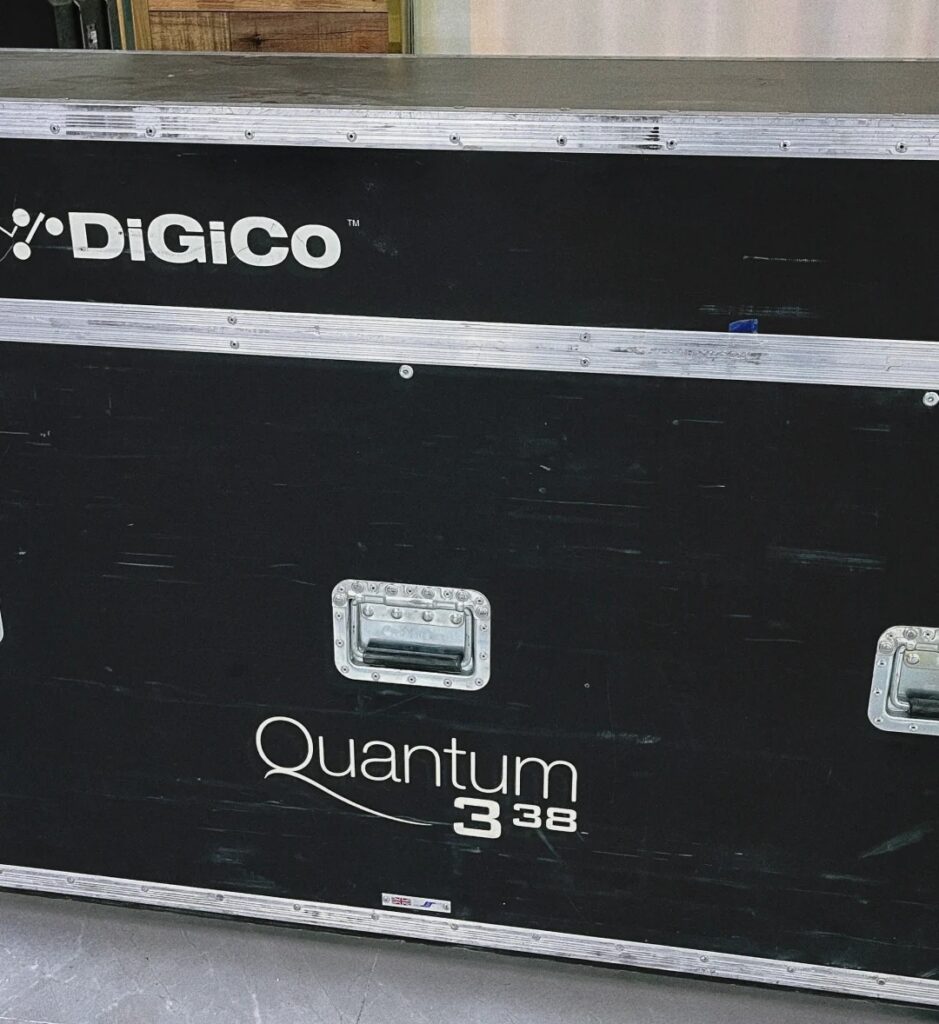
Several factors uniquely matter in arena touring that don’t apply to recording or installed broadcast applications:
1. Channel count headroom for festival stages. Arena tours with full production typically need 80-128 input channels. Festival main stages often run 150+ inputs across multiple acts. Console processing capacity must comfortably handle festival headlining requirements without compromising plugin/processing depth.
2. Network audio reliability and reach. Arena and stadium environments require 100+ meter cable runs from FOH to stage, redundant network paths, and bulletproof reliability under high-load conditions. Optocore (DiGiCo), proprietary Avid network, TWINLANe (Yamaha), and AES50 (Midas) all serve these needs, but with different operational characteristics.
3. Monitor mixing capability. Modern touring frequently uses the same console family for FOH and monitors, with shared show files between positions. Console must offer monitor-specific feature depth (deep aux send routing, extensive in-ear management, fast monitor send-on-fader operation).
4. Snapshot recall for festival changeover. Festival main stage operation requires changing between bands every 15-30 minutes, with complete show file recall between acts. Snapshot system must be fast and recall-accurate.
5. Rental house ecosystem compatibility. When the touring operation arrives in a remote market and needs a backup console from a local rental house, having a brand with mature rental house presence is operationally critical.
6. Engineer training continuity. Most professional touring engineers have deep specialization in one or two console brands. Switching brands creates retraining cost and increases operational risk on a tour where mistakes have visible consequences.
For broader live sound infrastructure context, see arena/festival live sound mixing console setup walkthrough.
The major flagship options for arena touring in 2026
DiGiCo Quantum 7
The dominant flagship for major arena and festival touring. DiGiCo Quantum 7 is specified on a substantial majority of major arena tours where the touring engineer has discretion.
Strengths: Stealth Core 2 processing engine (lowest end-to-end latency at the flagship tier, highest channel count headroom with full processing), mature Optocore networking with 1+1 fiber redundancy, comprehensive Mustard processing modules for channel character, deepest rental house ecosystem worldwide.
Weaknesses: steeper learning curve than some competitors, higher capital cost than Midas, less Pro Tools integration than Avid for hybrid live/recording applications.
Best for: major arena tours, festival main stages, touring monitor positions, applications where Optocore reliability and Stealth Core 2 processing depth are decisive.
Pricing: Quantum 7 system (surface + 2x SD-Rack + Optocore + redundant power) typically 110,000-180,000 USD.
Avid VENUE S6L
The flagship for Pro Tools-integrated touring applications. Avid VENUE S6L-32D is specified for tours where multitrack recording, plugin parity with studio sessions, or theatrical-style production matters.
Strengths: Pro Tools integration is class-leading (essential for tours that record every show or use studio plugin chains live), AAX plugin processing on the engine with parity to studio sessions, strong incumbent position in broadcast music TV (which influences touring artist preferences), excellent virtual soundcheck capability.
Weaknesses: lower channel count flexibility than DiGiCo Quantum 7, less mature rental house ecosystem outside North America, slightly higher latency than DiGiCo (1-1.5 ms vs 0.7 ms typical).
Best for: tours that record every show for live album/streaming use, theatrical touring productions, hybrid live-and-recording applications, tours with broadcast TV component.
Pricing: S6L-32D system (surface + E6L-192 engine + 2x Stage 64 + redundant power) typically 150,000-220,000 USD.
Yamaha Rivage PM10
The flagship for Asian markets and broadcast-touring crossover applications. Yamaha Rivage PM10 offers the highest channel count of the major flagships and excellent monitor capability.
Strengths: highest channel count at the flagship tier (144 channels at 96 kHz), comprehensive VCM processing library for vintage character emulation, mature TWINLANe and Dante networking, excellent monitor-specific feature depth, strong reliability track record.
Weaknesses: larger surface footprint than competitors, smaller rental house ecosystem outside Asia, higher capital cost for full Rivage system than DiGiCo or Midas equivalents.
Best for: Asian touring (Yamaha is dominant), tours with high channel count requirements, monitor positions where Rivage’s monitor feature depth is operationally valuable, broadcast-touring crossover applications.
Pricing: Rivage PM10 system (CS-R10 surface + DSP-RX engine + 2x Rio3224-D2) typically 180,000-280,000 USD.
Midas Pro X
The flagship for tours wanting analog character at flagship-tier capability. Midas Pro X offers Heritage 3000 processing engine character at competitive pricing.
Strengths: built-in analog character (Heritage 3000 engine emulates legacy XL series sonics), substantially lower capital cost than DiGiCo/Avid/Yamaha equivalents, mature DL-series stage I/O, AES50 networking proven on major tours.
Weaknesses: smaller rental house ecosystem than DiGiCo, less channel count headroom than Yamaha PM10 or DiGiCo Quantum 7, AES50 less interoperable than Dante for non-Music Tribe gear.
Best for: heritage rock and country touring, tours wanting analog character as default sound, budget-conscious flagship touring builds, Music Tribe ecosystem integration (Midas + Behringer + Klark Teknik + Lake).
Pricing: Pro X system (Pro X surface + 2x DL231 stage I/O + AES50 network) typically 65,000-100,000 USD.
For head-to-head context, see DiGiCo vs Avid VENUE comparison and Yamaha vs Midas Pro flagship live comparison.
How to choose: decision framework
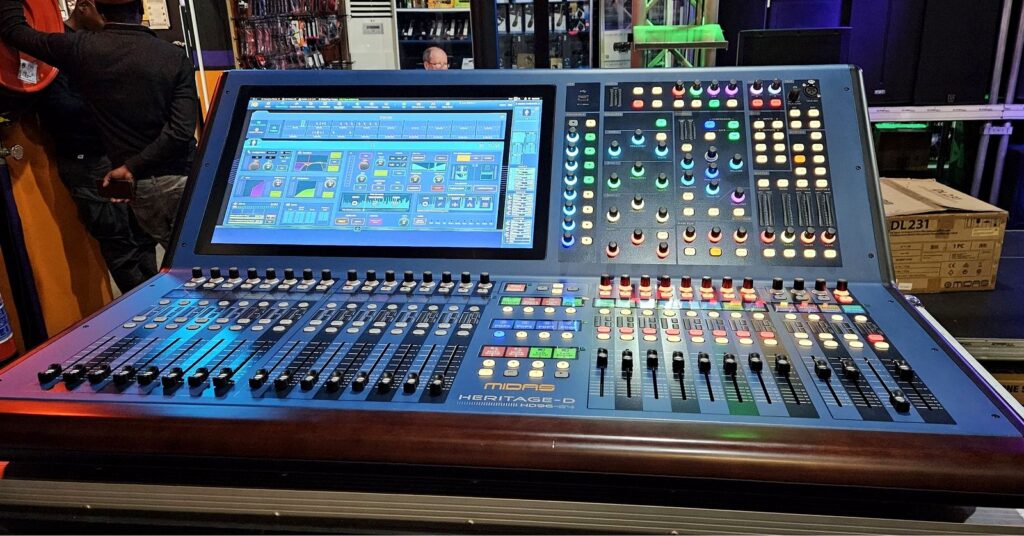
For a major arena tour with experienced FOH engineer:
- First choice: DiGiCo Quantum 7 (default flagship, broad rental house compatibility)
- Second choice: Avid VENUE S6L (if Pro Tools integration matters)
- Third choice: Yamaha Rivage PM10 (if Asian touring or high channel count required)
For a heritage rock or country touring act:
- First choice: Midas Pro X (Heritage character matches genre aesthetic)
- Second choice: DiGiCo Quantum 7 with Mustard processing (clean default + opt-in character)
- Third choice: Yamaha Rivage PM7 with VCM (clean default + opt-in vintage)
For a touring act that records every show:
- First choice: Avid VENUE S6L (Pro Tools integration class-leading)
- Second choice: DiGiCo Quantum 7 with MADI-to-Pro-Tools rig (more complex but higher channel count)
- Third choice: Yamaha Rivage PM10 with Dante-to-recording (good integration)
For a touring monitor position:
- First choice: DiGiCo Quantum 7 (deepest monitor feature set)
- Second choice: Yamaha Rivage PM10 (monitor capability class-leading)
- Third choice: Avid VENUE S6L (good for monitor with Pro Tools integration)
For a festival main stage rental flagship:
- First choice: DiGiCo Quantum 7 (broadest engineer training base, deepest rental fleet)
- Second choice: Avid VENUE S6L (specifically requested by some artists)
- Third choice: Yamaha Rivage PM10 (if Asian or hybrid broadcast requirements)
For a budget-conscious flagship arena tour:
- First choice: Midas Pro X (60-70% of competitor pricing for comparable capability)
- Second choice: Yamaha Rivage PM7 (smaller flagship at lower cost than PM10)
- Third choice: DiGiCo Quantum 5 (Quantum capability at lower cost than Quantum 7)
For complete touring infrastructure context, see arena/festival live sound setup walkthrough.
Where to buy
Touring flagship consoles are typically purchased through:
- Sweetwater (US) — comprehensive pro audio inventory with touring-specific support
- B&H Photo (US) — broadcast and live sound specialist
- Thomann (EU) — competitive European pricing on all major flagships
- Vintage King Audio (US) — pro audio with strong live sound team
- Group One Limited (US) — DiGiCo’s primary US distributor
- Avid Pro Solutions specialists for S6L touring installations
Many touring companies acquire consoles through their primary rental house relationships rather than direct purchase — Clair Global, PRG, Eighth Day Sound, and similar companies maintain large console inventories and provide ongoing engineer support across tours.
Bottom line
For arena and major festival touring in 2026, the best digital mixing console depends on operational tier, genre context, and engineer training:
- Major arena tour, default specification: DiGiCo Quantum 7
- Pro Tools-integrated or theatrical touring: Avid VENUE S6L
- Asian markets or high channel count: Yamaha Rivage PM10
- Heritage rock/country or budget-conscious flagship: Midas Pro X
- Touring monitor position: DiGiCo Quantum 7 or Yamaha Rivage PM10
The flagship touring console is a 5-10 year capital investment with major operational implications. Choose based on engineer training, rental house compatibility in target markets, and genre-fit sonic philosophy.
For the broader context on professional mixing consoles, return to our professional mixing console 2026 expert guide.
Where to buy : DiGiCo Quantum 7
| Retailer | Why | |
|---|---|---|
| Thomann | Reference price, 3-year warranty, pro stock in Europe | Check price at Thomann → |
| Amazon | Fast shipping, used and renewed units | See on Amazon → |
Affiliate links: the price is the same for you, the commission funds our tests. As an Amazon Associate we earn from qualifying purchases.
Read also: Essential accessories for your mixing console · Which studio headphones should you choose? · Mixing console market 2026: trends and analysis
→ See all our Le Fader ratings
🎚️ Essential accessories for your mixing console
As an Amazon Associate I earn from qualifying purchases.