
Understanding professional mixing console signal flow is foundational for working pro audio engineers. While the basics — input through channel strip to master bus through outputs — are familiar to anyone who’s used a mixer, professional consoles introduce architectural complexity that requires careful study: in-line versus split topologies, pre- and post-fader send routing, insert point placement, multiple bus structures, monitor matrix design, and the difference between channel summing topology and bus summing topology. This guide provides a comprehensive technical foundation for engineers working at the flagship and high-end commercial tier.
The fundamental signal path
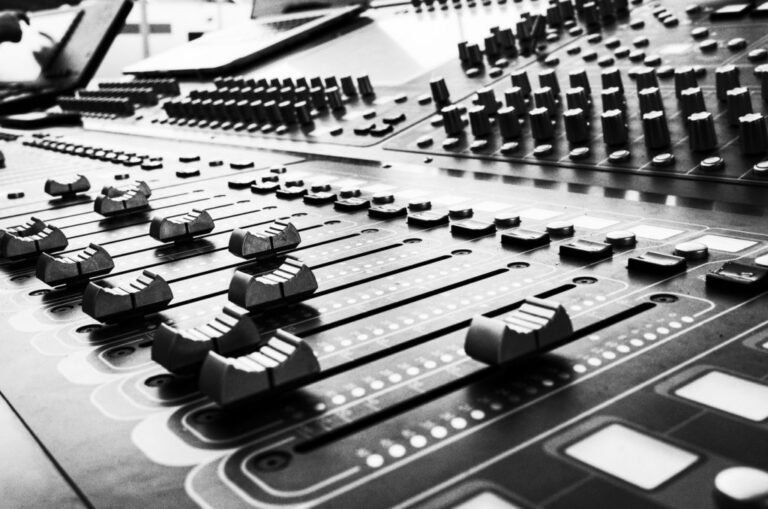
A professional mixing console’s signal path follows this general structure:
- Input stage — mic preamp or line input, with input gain control and high-pass filter
- Channel strip processing — typically EQ, dynamics, with order configurable on flagship consoles
- Insert point — analog or digital insert send/return for outboard processing
- Channel fader and pan — primary level and stereo placement control
- Bus routing — assigns the channel signal to subgroup buses, master bus, and matrix
- Aux sends — sends derived from the channel signal for monitor mixes, effects sends, and broadcast feeds
- Master section processing — bus compressor, master EQ, monitor matrix
- Output stage — analog output to stage I/O, broadcast feed, or recording rig
The order of stages 2-5 varies by console and configuration. Some consoles allow swapping the order of dynamics and EQ; others fix the order. Insert points may appear pre- or post-EQ depending on console design.
In-line vs split topology
The most fundamental architectural distinction in professional consoles is in-line versus split topology:
In-line topology combines two signal paths per physical channel strip — the input path (signal from a microphone or line source going to the recording medium) and the monitor return path (signal coming back from the recorder for monitoring). Each fader can control either path or both. This topology was introduced on the SSL 4000B in 1979 and became standard for tracking consoles thereafter.
In-line consoles include all modern SSL frames (Origin, Duality), Neve Genesys, API 1608-II, Midas Heritage 3000, and most modern flagship analog consoles.
Split topology uses separate input strips and monitor return strips. The engineer mixes monitor returns on one section of the console while another section handles input routing. This topology was standard for early-1970s flagships and remains in use on some specialty consoles, particularly mastering consoles and some API Legacy configurations.
Split topology requires more channel strips for equivalent capability but offers cleaner operational separation between input and monitor functions.
Pre-fader vs post-fader sends
Aux sends (used for monitor mixes, headphone feeds, effects sends, broadcast subfeeds) can be derived from the channel signal at different points:
Pre-fader sends take the signal before the channel fader. Moving the channel fader doesn’t affect the pre-fader send level. This is essential for:
- Monitor mixes in a recording session — the talent’s headphone mix shouldn’t change when the engineer rides the channel fader for the recorded mix
- Live sound monitor mixes — performers’ in-ear or wedge mixes shouldn’t change when the FOH engineer makes mix adjustments
- Broadcast subfeeds — international feed levels shouldn’t change with the host program mix
Post-fader sends take the signal after the channel fader. Moving the channel fader proportionally affects the post-fader send level. This is essential for:
- Effects sends — when you mute a vocal channel, you want the reverb send to mute proportionally so reverb tail doesn’t continue without the dry signal
- Recording feeds — when you mute a channel for the program, the recording feed should mute too
- Subgroup feeds to bus processors
Most flagship consoles offer per-send configuration of pre- or post-fader behavior. Some consoles offer pre-EQ versus post-EQ pre-fader options for additional flexibility.
For specific application context, see VCA vs DCA explained.
Insert points: location matters
Channel inserts allow outboard processors to be inserted into the channel signal path. The location of the insert point affects what processing it can do:
Pre-EQ insert — outboard signal is processed before the channel EQ. Used for outboard mic preamps (when the console preamp is being bypassed), for transient designers and gates that should operate on raw signal, and for de-essers.
Post-EQ pre-dynamics insert — outboard signal is processed after EQ but before the channel compressor. Used for parallel compression configurations and for outboard processors that should benefit from EQ shaping but precede dynamic control.
Post-dynamics insert — outboard signal is processed after both EQ and channel dynamics. Used for outboard processors that should operate on the fully-shaped channel signal (saturation, distortion, additional limiting).
Pre-fader insert — outboard signal is processed before the channel fader. Used for processors that should respond to channel processing but be affected by fader rides.
Post-fader insert — outboard signal is processed after the channel fader. Rare; used for specific applications where the processor should respond to fader-level signal.
Most flagship consoles offer configurable insert point placement. Some consoles are more flexible than others; budget that flexibility into your console choice.
Subgroup buses, master bus, and matrix
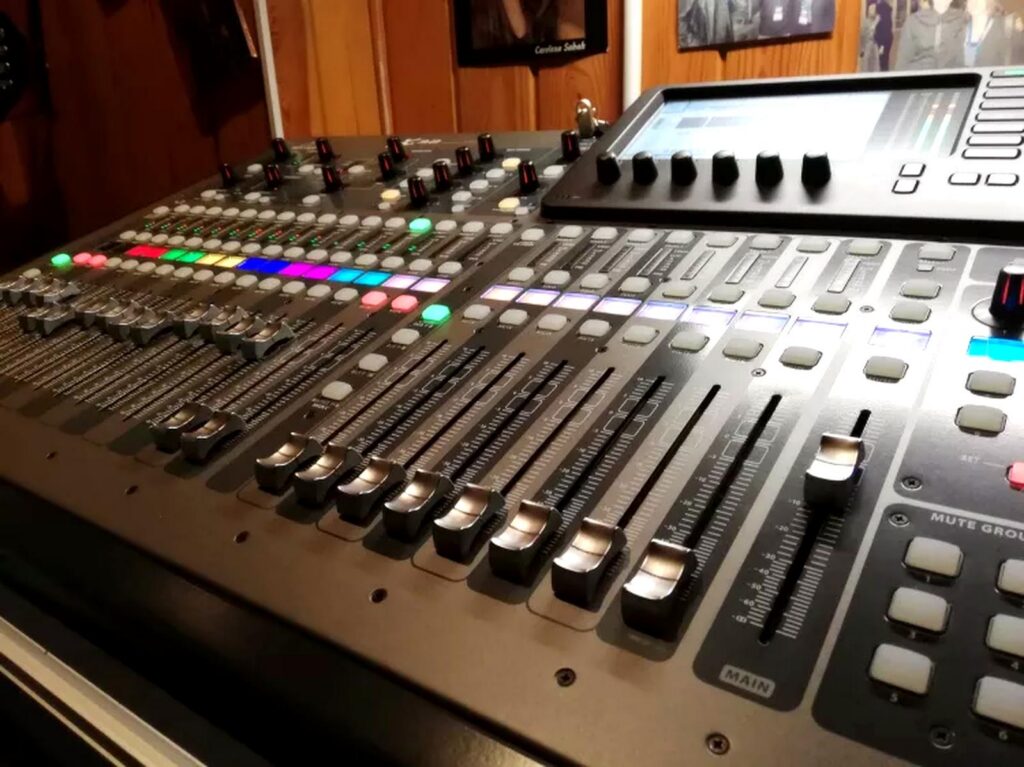
Beyond individual channel routing, professional consoles offer several bus structures:
Subgroup buses are intermediate stereo (or mono) buses that sum multiple channels for group-level processing. Drum bus, vocal bus, instrument bus are common configurations. Subgroup buses can be processed (with bus compressors, EQs, additional outboard) before being routed to the master bus.
Master bus is the main stereo (or surround) output bus that drives the primary recording feed, FOH output, or broadcast main feed. The master bus typically has dedicated processing — bus compressor on SSL frames, master EQ on Neve frames, comprehensive metering, and monitoring controls.
Matrix outputs are configurable buses that can take any combination of channels, subgroups, and master bus to create custom output mixes. Common applications include:
- Theater speaker zone feeds (separate level for front-of-house, balcony, side-fills)
- Broadcast subfeeds (host country feed, international feed, world feed all from same source)
- Recording stems (separate drum stem, vocal stem, instrument stem for post-production)
- Live recording feeds (separate feed to recording rig with different processing than FOH)
For multi-format broadcast applications, see multi-format routing for broadcast mixing consoles.
Channel summing vs bus summing topology
The way analog consoles sum signals matters sonically:
Channel summing topology describes how individual channels combine before reaching the bus stage. Most analog consoles use voltage-mode summing through resistor networks driving an op-amp summing stage. The character of this stage affects the console’s overall sound — particularly how the console behaves at high channel counts with many simultaneous signals.
Bus summing topology describes how the master bus combines its inputs. Neve consoles traditionally use transformer summing on the bus output (contributing harmonic content). SSL consoles use IC op-amp summing (cleaner, less harmonic content). API consoles use discrete op-amp summing with output transformers (different from both Neve and SSL).
These topology differences are part of why different analog consoles sound different — they’re not just about channel strip processing, they’re about how the console behaves when summing many simultaneous channels.
For broader sonic context, see SSL vs Neve comparison and digital vs analog pro mixing console comparison.
Monitor matrix and control room signal flow
The monitor matrix is the section that handles control room and headphone monitoring. Professional monitor matrices include:
- Source selection — switch between master bus, recording return, alternate sources, headphones-only sources
- Speaker selection — multiple speaker pairs (mains, near-fields, alternate references), with calibrated level matching
- Headphone matrix — multiple headphone outputs with independent source selection (engineer monitor different from talent monitor)
- Talkback — engineer voice routing to talent headphones, with auto-dim of program signal
- Sum/cut/dim — fast monitor controls for level adjustment without changing main mix
- Mono fold-down — checking mono compatibility of stereo mixes
Mastering consoles take this further with extensive reference monitoring switching — see SPL DMC mastering console guide and best mixing console for mastering studio 2026.
Digital console signal flow specifics
Digital consoles (DiGiCo Quantum, Avid VENUE S6L, Yamaha Rivage) implement the same logical signal flow but in DSP rather than analog circuits. Specific differences:
- Bit depth and precision matter. Flagship digital consoles use 32-bit or 64-bit floating-point internal precision to maintain headroom across complex signal paths.
- Latency accumulates through processing stages. Each plugin or DSP stage adds latency; flagship consoles use lookahead and delay compensation to maintain phase coherence.
- Routing flexibility is greater. Digital consoles can typically route any input to any bus with arbitrary signal flow — analog consoles are constrained by physical patch points.
- Insert point options are more numerous. Digital consoles often offer 6+ insert points per channel versus 1-2 on analog consoles.
- Format flexibility is built in. Digital consoles handle stereo, surround, immersive within the same processing engine; analog consoles require explicit signal path provisioning for each format.
Bottom line
Professional mixing console signal flow is foundational engineering knowledge. Understanding in-line versus split topology, pre- and post-fader send routing, insert point placement, subgroup and matrix bus structure, and console-specific summing topology helps engineers make informed equipment choices and operate consoles efficiently in pro contexts. For working pro audio professionals, this knowledge is essential — particularly for engineers moving between analog and digital workflows or between recording and broadcast applications.
For the broader context on professional mixing consoles, return to our professional mixing console 2026 expert guide.
Read also: VCA vs DCA in pro mixing consoles: complete technical guide · Pro mixing console maintenance and care: complete owner’s guide
🎚️ Essential accessories for your mixing console
As an Amazon Associate I earn from qualifying purchases.