
A flagship recording studio mixing console setup is more than a console purchase — it’s an integrated facility design where the console, outboard rack, monitoring infrastructure, patchbay, and acoustic environment must work together at world-class standards. Studios at this tier (Capitol, Electric Lady, Blackbird, Sunset Sound, Hansa, AIR Lyndhurst) command 1,500-3,500 USD day rates, and clients expect every element of the signal chain to perform without compromise. This guide walks through the components and decisions involved in specifying and installing a flagship-tier recording studio centered around a professional mixing console. Total facility budgets typically range from 400,000 to 2,500,000 USD, with the console itself representing 80,000-500,000 USD of that figure.
For broader context on the consoles that anchor these facilities, see our pillar guide to professional mixing consoles 2026 and our best high-end mixing console for pro studio 2026 buyer guide.
Console as the architectural anchor
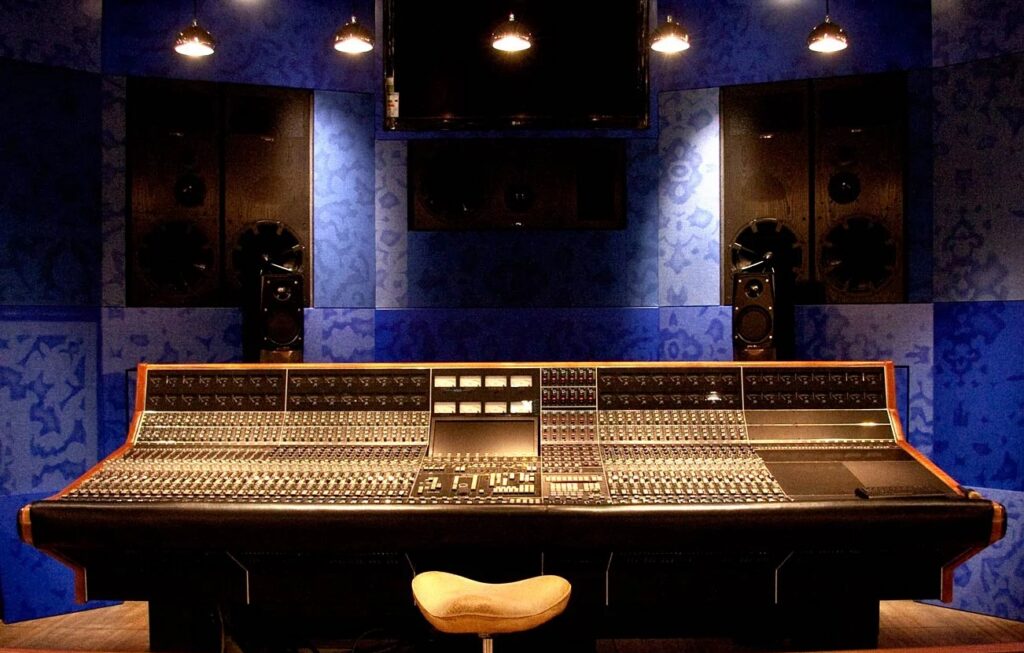
The console choice is not just a sonic decision — it physically defines the control room layout. A 64-fader SSL ORIGIN32 needs roughly 2.4 meters of width and 1.5 meters of operator depth. A 72-channel Neve 88R or vintage VR72 frame approaches 3.5 meters wide and weighs over 1,200 kg, requiring reinforced flooring. The room must accommodate the console, the producer/client area behind it, the rear monitoring sweet spot, and the equipment racks within reach.
Three console categories anchor flagship recording studios in 2026:
Modern analog flagships — SSL ORIGIN32 (~210,000 USD), Neve Genesys G32 (~175,000 USD), API 1608-II (~135,000 USD), or the larger API 2448 (~250,000 USD) define the modern analog tracking and mixing experience.
Vintage flagships — restored SSL 4000G+ (90,000-130,000 USD), Neve VR60/VR72 (60,000-110,000 USD), or rarer Trident A-Range and vintage Neve 80-series consoles (150,000+ USD) bring documented historical character. See our vintage console restoration guide for ownership realities.
Hybrid digital-analog — Avid VENUE S6L systems with analog summing, or smaller analog consoles (24-32 channels) used for summing and front-end character with extensive ITB workflow. See console vs DAW comparison.
Most major-label-targeting studios choose modern analog flagships for warranty support, while heritage-positioned studios (the Abbey Road / Capitol / Hansa model) maintain vintage consoles as their distinctive identity.
Outboard rack — the supporting cast
A flagship recording studio runs 30-80 channels of outboard processing alongside the console. Typical outboard for a major-tier studio includes:
Preamps — Neve 1073/1081, API 312/512, Telefunken V72/V76, Neumann V476, Manley SLAM!, Avalon VT-737sp, Universal Audio LA-610. Studios often run 16-24 channels of premium pre on top of the console’s onboard preamps.
Compressors — Fairchild 670 (or Heritage Audio reissue), Teletronix LA-2A originals or reissues, Urei 1176 originals or reissues, SSL G-series Bus Compressor, Manley Vari-Mu, Empirical Labs Distressor, Tube-Tech CL1B, Smart C2.
EQ — Pultec EQP-1A and MEQ-5 originals or Manley/Tube-Tech variants, Massive Passive, GML 8200, Sontec, Maag EQ4.
Effects — Lexicon 480L, EMT 250 (or Universal Audio plate reissue), AKG BX20, Bricasti M7, Eventide H3000/H9000.
A/D-D/A — Prism Sound ADA-8XR or Lyra 2, Apogee Symphony Mk II, Burl B80 Mothership, Antelope Galaxy 64. Conversion quality at the highest tier matters more than most engineers realize.
Total outboard investment in a flagship facility ranges 150,000-400,000 USD.
Patchbay infrastructure
The patchbay is the unsung hero of professional studios. A flagship facility typically runs 1,200-2,400 patchbay points across 12-24 patchbays, all wired with high-quality cable (Mogami 2792 or Canare star-quad bulk cable). Bantam TT (1/4-inch tinier-tinier) is the professional standard; full-size 1/4-inch TRS bays are now legacy. Some broadcast-leaning studios use Bittree HD Series patchbays or dedicated AES67 networking patchbays for digital audio.
Wiring labor alone for a flagship facility runs 30,000-80,000 USD. Studios employ specialists like Walters-Storyk Design Group, BOTO Design, or independent technicians like Klaus Heyne or John Klett to oversee installation.
Monitoring infrastructure
Reference monitoring at flagship level typically includes three to five tiers:
Mains — large soffit-mounted main monitors. ATC SCM150ASL Pro (~28,000 USD/pair), PMC BB6-XBD (~50,000 USD/pair), Quested H210 (~40,000 USD/pair), Augspurger Duo-15s, or custom builds.
Mid-fields — large near-fields for primary mix reference. ATC SCM45A, PMC IB1S-AIII, Adam S5H, Genelec 1234A.
Near-fields — Yamaha NS-10M (legacy), Genelec 8351B, Focal Trio6, ATC SCM25A.
Cube reference — Auratone 5C, Avantone Mixcube — for mid-range reality checks.
Headphones — Sennheiser HD650, Audeze LCD-X, Sony MDR-7506 — for client listening and mix verification.
Monitoring infrastructure typically represents 80,000-250,000 USD in a flagship facility.
Networking and infrastructure
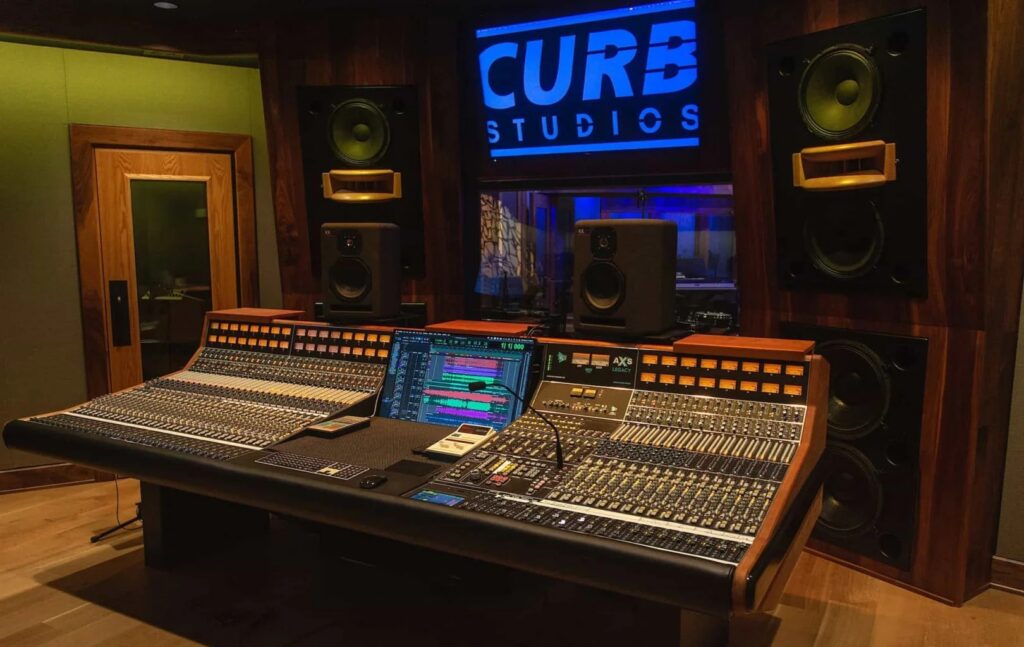
Modern flagship studios run hybrid analog and digital networks. A typical infrastructure includes:
Analog — multi-pin snakes (Mogami 3162) or mass-termination panels between live room and control room Dante/AES67/Ravenna — for digital audio routing and integration with Pro Tools systems MADI — for legacy connectivity and bulk channel transport Pro Tools HDX — flagship Pro Tools systems with 64+ channels of conversion
Pro Tools systems range from a single HDX/HD Native (12,000-25,000 USD) to fully redundant rigs with multiple interfaces and surface controllers (45,000-120,000 USD).
Acoustic treatment and electrical
The control room must meet professional acoustic standards. Reverb time targets are typically 0.25-0.35 seconds across the spectrum, with carefully managed first reflections and bass trapping. Acoustic treatment costs typically run 80,000-200,000 USD depending on room size and finish quality.
Electrical infrastructure requires dedicated isolated grounding and power conditioning. Equi=Tech, Furman P-3600 SMP, and Torus Power conditioners are common at the flagship level. Total electrical work typically runs 25,000-60,000 USD.
Live room considerations
The live room must match the control room in quality. A flagship live room of 80-200 square meters with 4-6 meter ceilings, variable acoustic treatment, multiple isolation booths, and tie lines to the control room represents another 200,000-500,000 USD investment depending on size and finish.
Sample budget breakdown — 600,000 USD flagship setup
- Console (modern SSL Origin or used Neve VR60): 150,000-180,000 USD
- Outboard rack (preamps, comps, EQs, effects): 200,000 USD
- Conversion and computers: 60,000 USD
- Patchbay and wiring: 60,000 USD
- Monitoring: 80,000 USD
- Acoustic treatment: 50,000 USD
- Electrical and HVAC: 20,000 USD
- Total: ~600,000 USD
A 1,500,000 USD setup (the Capitol Studios Studio C tier) approximately doubles each line item, with an SSL ORIGIN32 or vintage Neve VR72 as the centerpiece, multiple Pro Tools HDX rigs, ATC SCM300 mains, and concert-grade instrument collection.
Bottom line
A flagship recording studio mixing console setup requires integrated thinking across the console, outboard, monitoring, networking, and acoustic dimensions. Each element must operate at world-class standards, and the total facility cost reaches 400,000-2,500,000 USD before accounting for the building lease and operational overhead. The console itself anchors the facility but represents only 25-35% of total spend.
Studios at this tier are competing for major-label clients, A-list artists, and film score work. The combination of console, outboard, monitoring, and acoustic environment defines the studio’s identity for the next 15-25 years.
For console-by-console deeper analysis, see our brand guides on SSL, Neve, and API. For ongoing maintenance considerations, see our pro mixing console maintenance and care guide.
Return to our pillar guide to professional mixing consoles 2026 for full ecosystem context.
Read also: Arena and festival live sound mixing console setup: pro guide · Broadcast TV and radio mixing console setup guide: pro reference
🎚️ Essential accessories for your mixing console
As an Amazon Associate I earn from qualifying purchases.