
Studer is a name that carries unusual weight across two distinct domains in pro audio. To recording engineers, Studer means tape — the A800, A820, and A827 multitrack machines that defined analog recording from the 1970s through the early 2000s. To broadcast engineers, Studer means consoles — the Vista series, used by virtually every major European public broadcaster (BBC, ARD, ZDF, RAI, France Télévisions, NHK in Asia) and a long list of post-production houses worldwide. Founded in Switzerland in 1948 by Willi Studer and now part of Evertz Microsystems since 2020, Studer continues to produce the Vista line as its flagship broadcast offering.
This guide focuses on the Vista series — the consoles, not the tape machines — and the rationale for choosing Studer in a broadcast or post-production environment.
The Vista series in 2026: Vista 1, 5, 9, X, V
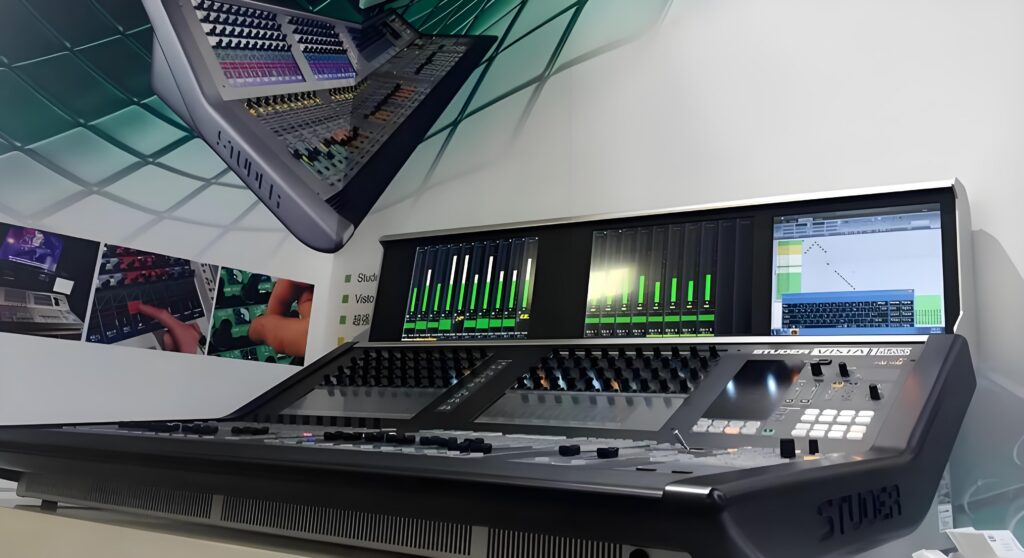
The Vista line is built around a single defining feature: the Vistonics interface, Studer’s hybrid touchscreen-and-rotary control surface. Each channel strip combines physical encoders with a small touchscreen that displays parameter values, EQ curves, dynamics graphs, and channel routing in real time. This approach — proprietary to Studer and never successfully copied by competitors — gives broadcast engineers fast access to every parameter without menu-diving, which is essential for live broadcast operations.
Vista 1 is the entry-level frame, 22 to 32 faders, aimed at radio studios and smaller TV facilities. Pricing starts around 90,000 USD.
Vista 5 and Vista 9 are the mid-tier and large-format broadcast consoles, 32 to 80 faders, used in mid-size TV studios, outside broadcast (OB) trucks, and post-production. Vista 5 typically runs 180,000 to 280,000 USD; Vista 9 runs 280,000 to 500,000+ USD.
Vista X is the flagship — 80 to 200+ faders, deployed at major broadcasters’ main production studios and large OB trucks. Pricing is project-specific but typically begins at 500,000 USD and scales to 1.2 million USD or more for fully loaded installations.
Vista V is the IP-native broadcast console, designed around AES67/SMPTE ST 2110 networking from the ground up. Vista V is the natural choice for broadcasters transitioning from MADI/SDI workflows to full IP infrastructure.
Why broadcasters choose Studer
Several factors explain Studer’s dominant position in European broadcast:
1. Vistonics ergonomics. The combination of physical rotary encoders with adjacent touchscreens is uniquely suited to live broadcast operations, where engineers need to make adjustments without removing their eyes from the program feed. Compared to all-touchscreen approaches (some competitor offerings), Vistonics is faster for skilled operators.
2. Robust automation and snapshot recall. Broadcast applications require fast, reliable preset changes between programs, commercials, and live segments. Studer’s snapshot system is fast and recall-accurate.
3. Long product support cycles. Studer maintains 15-25 year service support on Vista frames. A Vista 9 installed in 2010 will have parts available through at least 2035. This matters enormously for institutional buyers (public broadcasters, government installations, university radio facilities).
4. SDI/MADI/IP routing flexibility. Vista frames handle the full range of broadcast routing standards, with bridge interfaces between legacy and IP infrastructure.
For broader broadcast routing context, see our multi-format routing for broadcast mixing consoles guide.
Studer vs Lawo vs Calrec: the broadcast triumvirate
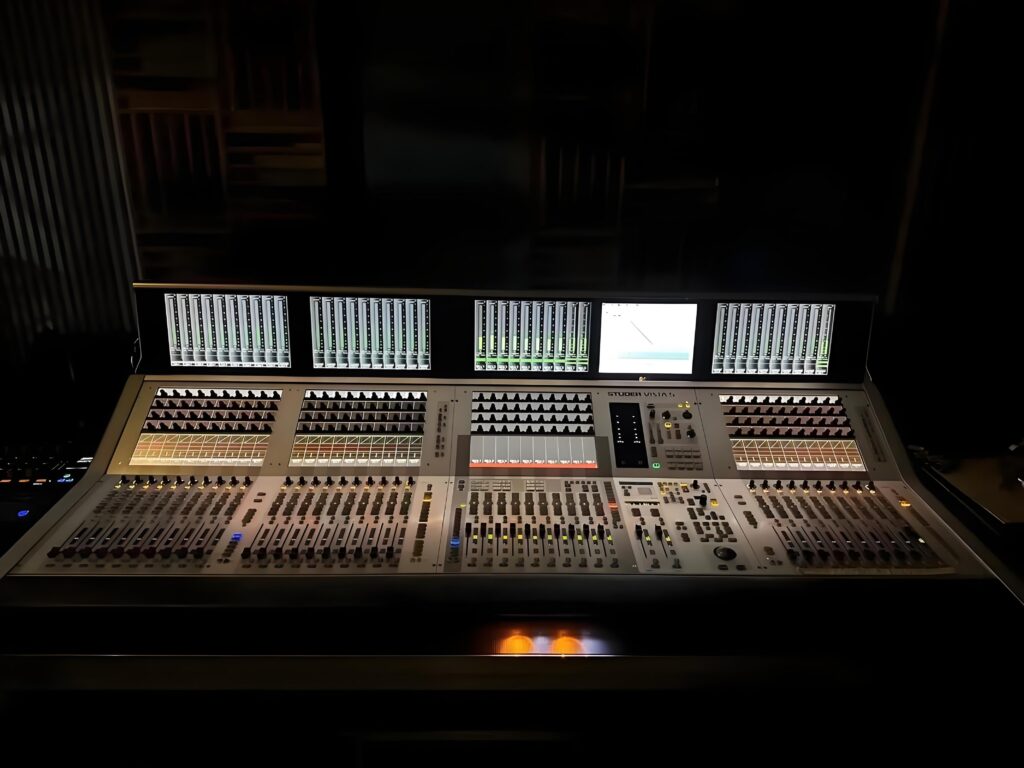
In the broadcast console market, Studer competes primarily with Lawo mc² series (German engineering, IP-native from the start) and Calrec Apollo/Summa/Brio (UK broadcast specialist, Hydra2 networking).
Roughly speaking: Studer is the European public broadcast default; Lawo dominates German and Eastern European TV plus modern IP installations; Calrec dominates UK broadcast and major sports broadcasting (Sky, BT Sport, NBC Sports for major events). All three are credible at the flagship tier, and the choice often comes down to incumbent infrastructure, engineer training, and integration with existing routing.
For US broadcast (where the market structure differs), Avid VENUE S6L and Yamaha Rivage hold larger shares than the European specialists.
Where Studer fits in a 2026 facility
Studer Vista is the natural choice for:
- European public broadcasters (continuity with installed base)
- Large OB trucks for sports, news, and live entertainment
- Post-production houses doing surround mixing for film and broadcast
- Government and institutional broadcasting installations
- Major radio networks with multi-studio facilities
For a complete broadcast installation walkthrough, see our broadcast TV/radio mixing console setup guide and best mixing console for broadcast 2026.
Where to buy Studer consoles
Studer Vista is sold primarily through factory direct and authorized integrators rather than through general pro audio retail. Sweetwater (US) and B&H Photo (US) handle smaller Vista 1 frames; large Vista 9 and Vista X installations go through Evertz/Studer factory teams, often with custom integration and on-site commissioning. Thomann (EU) carries some smaller Vista configurations. For the European broadcast market, direct Studer reps and regional integrators (Soundvision, Storyline, etc.) handle the bulk of installations.
Bottom line
Studer Vista remains a top-tier broadcast console in 2026 — the Vistonics interface is genuinely differentiated, the build quality is uncompromising, and the long-term support is unmatched. For institutional broadcast buyers, Studer is often the safe and correct choice.
For the broader context on professional mixing consoles, return to our professional mixing console 2026 expert guide.
Where to buy : Studer Vista 1
| Retailer | Why | |
|---|---|---|
| Thomann | Reference price, 3-year warranty, pro stock in Europe | Check price at Thomann → |
| Amazon | Fast shipping, used and renewed units | See on Amazon → |
Affiliate links: the price is the same for you, the commission funds our tests. As an Amazon Associate we earn from qualifying purchases.
Sources — manufacturer documentation consulted for this article: Studer.
→ See all our Le Fader ratings
🎚️ Essential accessories for your mixing console
As an Amazon Associate I earn from qualifying purchases.