
In the upper tier of touring live sound, DiGiCo is the dominant brand. Founded in the UK in 2002 as a spin-off from Soundtracs, DiGiCo built its position progressively through the SD series (SD7, SD5, SD10, SD9, SD11) and consolidated it with the Quantum series launched in 2018. Today DiGiCo desks are found on a very large share of major arena tours, festival main stages, and high-end corporate events at both FOH and monitor positions. The reasons are technical: FPGA-based Quantum processing, deep modular routing, mature Optocore networking, and a console design philosophy that prioritizes engineer workflow over feature count.
This guide covers the Quantum and SD series from a professional FOH/monitor engineer’s perspective.
The Quantum series: Quantum 7, 5, 338, 225
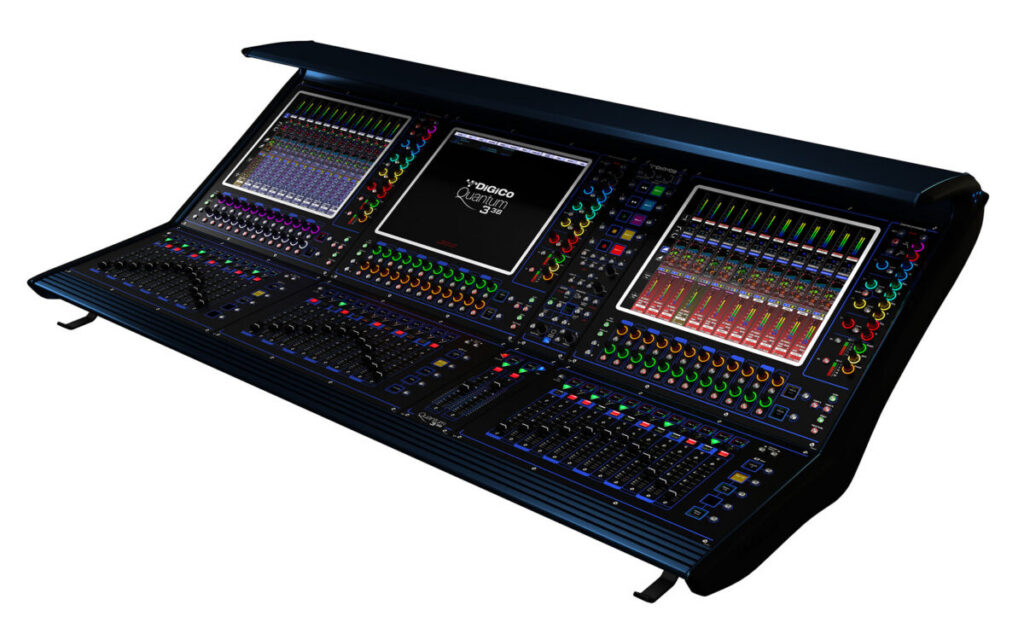
Quantum 7 (launched in 2018) was DiGiCo’s flagship until the arrival of the Quantum 852 in 2023, and remains one of the most specified consoles on major arena tours. It is a dual-engine console with 256 input channels and 128 aux/sub-group busses with full processing, a 48 x 48 matrix, 52 physical faders and three 15″ touchscreens, built on seventh-generation FPGA processing that delivers far more channel-count headroom than the SD-series engines it replaces. Pricing is on request and depends heavily on configuration; full touring systems with SD-Racks, Optocore loop and redundant engines sit well into six figures.
Quantum 5 (launched at NAMM 2020) is the smaller-format flagship — Quantum FPGA processing with up to 256 input channels and 128 busses, 37 faders and three 15″ touchscreens, aimed at theater, mid-size tours, and broadcast OB applications where Quantum 7’s footprint is excessive. Pricing is typically quoted on request, in the high five to six figures depending on configuration.
Quantum 338 sits below Quantum 5 — 38 faders (three banks of 12 plus two assignable), full Quantum processing, 128 input channels. Quantum 338 is the natural choice for mid-tier touring acts (theaters, festival second stages, corporate events); pricing depends on configuration and is typically in the upper five-figure range.
Quantum 225 is the entry-level Quantum — 25 faders, same processing core, 72 input channels, aimed at small theaters, regional touring, broadcast TV, and high-end corporate AV. Pricing typically sits in the mid five-figure range depending on configuration.
The legacy SD series in 2026
Many SD-series consoles remain in active service in 2026, particularly on rental fleets and second-tier touring. The SD7 (now superseded by Quantum 7 but still common on rental inventories), SD10, and SD12 continue to deliver excellent sound and reliable session recall. Used SD-series consoles trade widely on the rental and used market, at prices that vary strongly with model, age and I/O.
For a touring engineer, the practical implication is that a show file built on a Quantum will run on most SD frames with appropriate console version conversion — a meaningful advantage when arriving at a venue with whatever rental house console is on the floor.
Quantum processing and the DiGiCo processing philosophy
What separates Quantum from SD-series and from competitors is its processing platform, built on seventh-generation FPGA devices (the SD series runs DiGiCo’s Stealth Core 2 software). The practical implications:
- Low latency end-to-end with 96 kHz processing throughout
- Higher channel counts at full processing (up to 256 input channels on Quantum 7, 384 on Quantum 852)
- Mustard processing modules — vintage-style channel strip emulations on a per-channel basis
- Spice Rack internal effects rack with high-quality reverb, delay, and modulation
- Nodal processing for independent monitor mixes and engine partitioning
Compared to Avid VENUE S6L (HDX cards), Yamaha Rivage PM10 (DSP engine), or Midas Pro X (NEUTRON engine), DiGiCo’s processing depth and routing flexibility are widely considered class-leading.
For head-to-head context, see DiGiCo vs Avid VENUE comparison.
Optocore networking and SD-Rack I/O
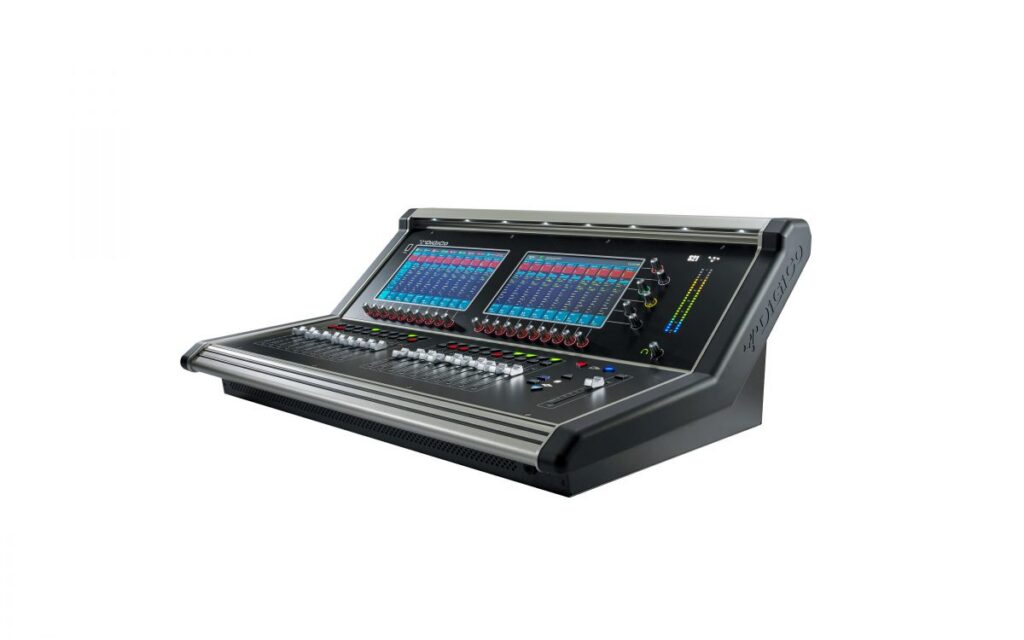
DiGiCo systems run on Optocore — an optical fiber network that handles audio transport, control, and clock between the console and remote stage racks. A typical large tour setup includes:
- SD-Rack (56 input / 56 output) at stage left, stage right, and FOH for redundancy
- Optocore loop with 1+1 fiber redundancy
- MADI bridge for connection to recording rigs, broadcast trucks, or backup consoles
- Dante card option for integration with non-DiGiCo systems
The Optocore loop is robust under cable failure (loop heals automatically if any single fiber breaks) and handles 100+ meter runs without repeaters.
Where DiGiCo fits in a 2026 facility
For touring FOH and monitor positions, Quantum 7 and the newer Quantum 852 are the defaults at the flagship tier. For mid-tier touring and theater, Quantum 5 or Quantum 338. For broadcast and OB, Quantum 225 or Quantum 5. For installed venues (concert halls, theaters, churches), the full Quantum range plus SD-series frames are widely deployed.
DiGiCo is less common in commercial recording studios — the live-sound feature set isn’t optimized for tracking workflows, and competitors like SSL, Neve, and API are stronger choices for studio use.
For application-specific guidance, see best digital mixing console for arena tour 2026 and our arena/festival live sound setup walkthrough.
Where to buy DiGiCo consoles
New DiGiCo Quantum consoles are sold through Sweetwater (US), B&H Photo (US), and Thomann (EU), plus regional pro audio integrators worldwide. Many touring companies buy through DiGiCo directly or its regional distributors (such as Group One Limited in the US). Used SD-series frames trade actively on Reverb.com and through used pro audio dealers.
Bottom line
DiGiCo Quantum is the dominant flagship for touring live sound in 2026. FPGA-based Quantum processing, mature Optocore networking, and a long track record on world-class tours make Quantum 7 and Quantum 852 the default specifications when budget allows.
For the broader context on professional mixing consoles, return to our professional mixing console 2026 expert guide.
Where to buy : DiGiCo Quantum 338
| Retailer | Why | |
|---|---|---|
| Gear4music | Reference price, 3-year warranty, pro stock in Europe | See digital mixers at Gear4music → |
Affiliate link: the price is the same for you, the commission funds our tests.
Read also: Solid State Logic (SSL) mixing consoles: complete guide to the SSL legacy · Neve mixing consoles: vintage and modern flagship guide
Sources — manufacturer documentation consulted for this article: DiGiCo.
Read also: DiGiCo SD12 review · DiGiCo Quantum 338 review
→ See all our Le Fader ratings
Useful accessories
Gear4music / Thomann affiliate links: the price is the same for you, the commission funds our tests. Products checked on 28/09/2026; price and stock on the retailer page.
- DI box : Radial Pro DI
- XLR cable : Studiospares Plus XLR (5 m)
- Console lamp : Littlite 18XR-4-LED
- Monitoring headphones : beyerdynamic DT 770 Pro (250 ohms)